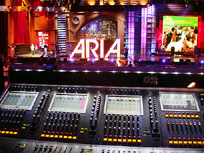
 The event was broadcast live on National TV and featured live performances of many Australian recording artists including John Farnham, Keith Urban, Delta Goodrem, Powderfinger, Darren Hayes and Something for Kate. JPS designed and supplied the sound system required for this technically demanding event which featured two live stages with two separate monitor, control and speaker systems to cater for the back to back live performances from each stage. JPS supplied for FOH a Digico D5 112EX digital mixing console and Digitracs recorder. This technology enabled the JPS engineers to rehearse and then recall all the individual settings for each of the artists. JPS supplied a soundcrew of ten (including technicians and engineers) along with a speaker system consisting of L-ACOUSTICS V-DOSC, dV-DOSC, ARCS and SB218 cabinets.
Category: Concerts
-
DiGiCo D5 for 2003 ARIAS
-
VerTec for NRL Grand Final 2003
 On the evening of Sunday 5th October, 2003, the NRL held its Rugby League Grand Final at Telstra Stadium to a capacity crowd of 82,000 spectators. As pre-game entertainment for the crowd live performances by Meatloaf, Hoodoo Gurus and Kelly Clarkson took place. JPS provided a distributed field system comprising of 54 Vertec 4889 cabinets, on 18 JPS custom karts, 36 Crown MA5002VZ amplifiers and 4 BSS FDS366 Omnidrives. The Vertec system covered all of the stadium and the house Bose system was only used to supplement coverage in the top sections of upper Eastern and Western stands. JPS supplied 2 Senior engineers, Greg Rosman and Michael Waters, along with 12 JPS audio staff/technicians. The complete Vertec system was removed from the field in just 6 minutes after the live pre-match entertainment.
 -
dV-DOSC for World Title Fight 2003
 On 3rd September 2003, Australian boxer Anthony Mundine defeated Antwun Echols to win his first World ‘super middleweight’ title fight in Sydney. This title win continues the family boxing tradition started by his father Tony Mundine, a famous Australian boxer in the 60’s. This event was at the Sydney Entertainment Centre to over 8,000 people and was televised live to cable TV worldwide. JPS designed and provided a unique centre cluster L-ACOUSTICS speaker system. This system comprised of a total of 58 X dV-DOSC and 14 dVSUBS flown in various configurations to suit the 360 degree coverage for the seating areas. To overcome the long speaker cable runs normally associated with a flown central cluster in arenas, JPS powered the system with flown amp racks each containing Crown MA5002VZ amplifiers. The L-ACOUSTICS dV-DOSC system provided exceptional coverage and speech intelligibility along with plenty of ‘knockout’ punch.
View image gallery -
John Farnham ‘The Last Time’ with DiGiCo D5
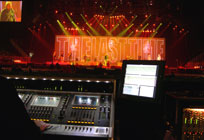 On Sunday June 15th, 2003 John Farnham chose to perform his last concert at Rod Laver Arena at Melbourne Park. This was John Farnham’s 86th show at Rod Laver Arena and celebrated his one millionth patron in the arena alone, a milestone that no other performer has ever achieved. The final performance of ‘The Last Time’ tour was an emotional farewell concert for a great Australian artist.
Jands Production Services provided the sound for the live audience and supplied the very latest in digital live mixing technology, ‘the DiGiCO D5’ for FOH, along with an L-ACOUSTICS V-DOSC System, powered by Crown MA5002VZ amplifiers with BSS controllers, and an audio crew of six. John Farnham’s FOH engineer, Grant Walsh, had specified the D5 for FOH and this was the first time an Australian artist had used the D5 in a concert setting.
Also used on the event by Metropolis Audio, in conjunction with another D5 console for the broadcast, was the DiGiCO DiGiTRACS 56 track hard disk recording system. This recording was used for the now released 5.1 DVD of the concert.
View image gallery -
Cold Chisel Ringside with VerTec
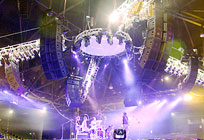 Legendary Australian Band ‘Cold Chisel’ performed for a series of one off concert performances in the round called ‘Ringside’. These performances, over four nights, held at the Hordern Pavillion in June 2003 in Sydney, were recorded for an upcoming DVD. Demand for tickets to these shows was so great that almost all shows were sold out immediately after they went on sale.
JPS designed and supplied a JBL Vertec system powered by Crown MA5002VZ Amplifiers and controlled by BSS 366 omnidrives.
The system comprised of 36 X Vertec 4889 cabinets which were flown ‘in the round’ in six clusters that were each six deep. Also used were 24 X JPS sub cabinets and 12 X JBL 4892 array cabinets for stage infill.
View image gallery -
DiGiCo D5 at The Annual Rotary International Conference
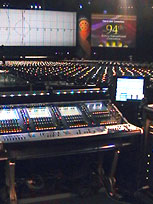 The Annual Rotary International Conference was held in June 2003 at the Brisbane convention centre. This conference attracted 20,000 delegates from overseas and within Australia.
The conference featured a broad range of Australian artists including Graeme Connors, Queensland Youth Orchestra, The Bangarra Dance company and others.
JPS was contracted by the event producer ‘Design Troupe’ to supply a sound system for the main 3 halls in the Convention centre. This system design included an L-ACOUSTICS V-DOSC/ dV-DOSC speaker system and the latest addition to the JPS rental inventory the ‘Digico D5 Live’ console.
The flexibility of the D5 112 EX digital console enabled the JPS engineers to rehearse and then recall all the various artist settings allowing greater efficiency and qualitiy of sound for all of the performances, speech and presentations.
View image gallery -
Silverchair “Across the Night” 2003
Article courtesy of CX Magazine (May/June 2003 issue)
Silverchair approached Rolling Stones levels of interest and enthusiasm on their Australian Tour across autumn. The five week run was designed for theatre and stadium, and featured an Australian pragmatism that a forty year old band like the Strolling Bones could never achieve.

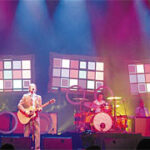
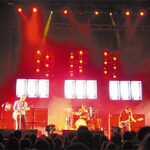
The parallels – guitar rock band; theatre AND stadium shows; fans who are welded on. The differences? About 150 people less on tour with the Chair. No physiotherapist, no personal chefs, no valets.
Production values were similar, and in proportion too. Where the Stones toured the largest LED video wall currently in use on the planet, the Chair toured the new Barco LED wall from Technical Direction Co – Australia’s largest and best new wall. The Rolling Stones had a new line array PA – the Chair had a modern NEXO Alpha PA system.
Patrick Woodroffe’s lighting design for the Stones had everything that moved, all controlled from a Hog II. Hugh Taranto’s design for Silverchair had more than enough in the way of fixtures – controlled from a Whole Hog III.
What I’m getting at, is that Production Values need to fit the scale of the show, and the Rolling Stones 14 truck tour is not that far removed from Silverchair’s two truck loads. The people who matter – the audience – were well satisfied in both cases.
I caught the tour at the Pallais Theatre and then two days later at the Vodafone Arena. The light and vision production was essentially the same in both venues, with less speaker boxes used for the 2000 Pallais than for the 6000 seat Arena. “It scales up nicely”, said the polite Hugh Taranto, veteran of many Silverchair tours. His lighting design was clever, because there was nothing flown in the grid that needed focusing, so no one needed to climb up there. That made a huge time saver, since the house worklights didn’t need to go out, and the safety issues of not having climbing crew are obvious.
“We can go up there (there is a ladder) and we have the rescue gear. But if we need to change something we usually lower the grid.” I have arrived at the Arena at 3pm, and Hugh is sitting arranging his cues. The load in was at 0800, so good time has been made. The stage set is loosely based on the Diaorma album cover, so rainbow colours and weird set pieces are used. Three LED video walls are flown at the rear quarter of the stage, hung intentionally crooked. Huge fake picture frames make them look kind of grunge-retro. Each wall is 5 panels wide and 3 tall, so they each measure about 4.5 x 2.5 metres.
Hugh operates the Whole Hog III, a wingboard, and three Catalysts – with 3 Mac G4 and 2 laptops. His FOH setup is complex, and hubbed together via an Ethernet switch. It is impressive to watch him work all this, alone, while calling two followspots. For the first half of the show, the three Silverchair members are joined by two guest keyboard players who are set on stage left, above and behind the backline. Coloured panels are over each backline speaker. Six ‘zip rings’ which are a circle of ten MR 16 lamps, are hung around the backline, giving Hugh another element to go with six Zip strips – sitting vertically around the stage, and gelled in rainbow hues.
The band take to the stage with pungent incense burning, plumes of smoke rising, and do a set of new material than builds to a break. Hugh has imagery generated from 3 Catalyst systems (with 3 Mac G4’s) feeding the three screens. The images combine moving black and white clips from band videos, and a smorgasbord of patterns generated on Catalyst. As the sole lighting operator, Hugh has control over outputting the images through the Hog III – making the show very harmonized.
“For the first half, the screens are set to 1000 nits. Then I turn them up (to 2000) for the second half. I’m using them more like lights them. They come in and flash, in colours, and are a big bright light.” Bright they are! The band wanted a quieter set with a different look for the first half. Behind the three oversized picture framed LED walls is a red drape. Lights play out a lot of looks, and two followspots very subtly fill out.
The second half is achieved after the crew reset the stage behind a curtain. The rear red drape is gone, revealing three pods of 24 Par 64’s, using 240v lamps so they can be chased in many combinations. Each is gelled.
A directive from the band is that the second half is not full of technology looks, so the moving lights are generally restricted to reset when dark, not moving while on. “It’s a traditional rock show – not the different world theme of the first half “, says Hugh. At the sound desk the two halves of the show are simply delineated by volume. The show grows louder as the night goes on. By the second half it is pumping fat, or phat as we call it in soundland.
This tour marks the first time that Melbourne sound engineer Bruce Johnston has mixed the band. The former Chair engineer took a gig in the USA, and the band had been looking to use Bruce for a while.
Bruce also owns a sound compact company – JAS – which means he was naturally keen to tender to supply equipment for the tour. He won. “I would use whatever they wanted to use, bar one kind of system that I have on my contract”. Bruce wouldn’t say which is the brand of system he dislikes, or why.Bidding for the tour was intense, but Bruce’s system choice of Nexo won the contract. Owning it means the contract wasn’t awarded by Bruce in any case, the decision went back to management with recommendations from Baily Holloway, the crew boss.
60 Alpha boxes made up the rig, 24 M3 (mid/ high); 24 B1 (low) and 12 S2 subs were flown and floor stacked to cover the audience. These were powered by just 2 amp racks per side – each rack loaded with four Camco Vortex 6 ultra-high powered amplifiers. Each rack produced 24,000 watts for a system total of 96,000 watts.
For the first time, Bruce used all Nexo on one tour, as the monitor system was also Nexo branded. Rod Matheson generated 4 in ear, and eight equalized sends of stage monitors from a Midas XL 250 console. 14 Nexo PS15 wedges were used, along with 2 Alpha E full range boxes on each side of stage as sidefills.
Out at front of house, the mixing console was an ageing but still good PM 4000, which is the top of the line desk in the JAS inventory. “I’m buying a Midas XL4, because when everyone is busy they are hard to get”, Bruce explained, adding that it can cost $2,500 a week to cross hire one. Some changes arose with the Silverchair sound when Bruce started the tour with the band. Previously the band used almost all triggered drums, with as few as eight open microphones on stage. “The band’s drum kit was all electronic except the snare and overheads”, said Bruce. “We changed that! It’s more melodic now, the samples just didn’t cut it. There’s more light and shade in the kit (sound).”
“We cut a hole in the front of the kick (for a mic) and re-skinned the kit. We put a note on the song list for Ben (Drummer) to retune the snare after the third number.
The samples are still sent to the desk from the drum tech area, so there are a massive 16 drum channels. Only the snare is still mainly sampled, “the kit is 90% live now”, asserted Bruce. The almost vintage but still popular Yamaha SPX 990 features as a snare reverb, Bruce says he just can’t escape the 1980’s. With four guitar inputs, bass, and two keyboard players – one of whom has a Leslie (rotating) speaker box, the rest of the desk inputs are filled.
“He (Daniel Johns) is a soft singer, so I ride his gain. I got an Avalon tube preamp for his channel and noticed the difference from the PM4k input preamp straight away. There is shit for days, like ride (cymbal) and guitar that will come through the vocal mic.”
Bruce is referring to stage spill. This band has an enormous live rock guitar sound. Truly phat, creamy and about 420 horsepower. During the final part of the show, when the three core musicians are alone on stage, Silverchair are possibly the tightest hard rock band on the planet.
Dates
March 19, 22-23, 25, 28-29
April 1-2, 5-6, 8, 10-11, 13, 15, 17, 19, 20 2003 -
Jack Johnson 2003
Jack Johnson – on the road with Bruce Johnston – and Geo-T
When Jack Johnson toured Australia and New Zealand recently he asked his Australian Tour Manager Nik Tischler to find FOH and monitor engineers for the tour.
Nik straight away called Bruce Johnson and Drew Menard. Nik said, “I have worked with Bruce and Drew on a number of international tours of Australia and knew they were the most competent and able guys in the country. That Bruce comes with his own PA system wasn’t a consideration – quite simply Bruce was the best man for the job – as his work with Oasis and silverchair shows.”
Mixing Jack Johnson gave Bruce the chance to take out his brand new system – the amazing Nexo Geo-T in Canberra and Brisbane. At the Palais Theatre in Melbourne the system was Nexo Alpha and the three Enmore Theatre shows in Sydney utilised the in-house EAW system.
“Mixing Jack Johnson on the Geo T was a dream,” said Bruce. “Actually all the shows were great – we had put the house system in the Enmore a while ago but hadn’t actually mixed on it – I was really impressed with how good it sounded.”
The system for the Canberra show highlighted some of the many benefits of the Nexo Geo-T. The whole system fitted easily into an 8 tonne truck, and its capability to be flown at a high trim creates clearer sightlines. Unlike many other line-array systems, Nexo Geo-T is flown from within its own footprint. The system for Jack Johnson was down and in the truck inside an hour!
Dates
April 6, 11 and 14 2003
-
Carlos Santana in Central Park with i4
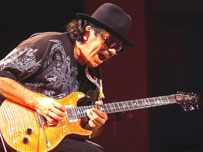 Carlos Santana’s ‘Shaman’ World tour arrived in Australia in March 2003. The tour played indoors for Brisbane and outdoors for Sydney, Melbourne, Adelaide and Perth.
The Sydney shows were held in ‘Centennial Park’ to an audience of over 20,000 people. Contemporary Australian band ‘Yothu Yindi’ opened the show each night as the well appreciated support act.
JPS provided a 48 Clair i4 speaker system with 36 Clair i4B sub cabinets. Powering the cabinets were Crest 10-004 and QSC 9.0 amplifiers. The system was controlled by the new innovative Clair iO System.
Carlos Santana’s virtuoso performance and the i4 System provided a great outdoor musical experience for all music lovers and Santana fans who were on hand to witness the event.
View image gallery -
James Taylor with the Clair i-4/IO System
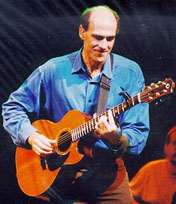 Grammy award winner ‘James Taylor’ and his incredible band toured Australian theatres in early February 2003. The tour ‘sold out’ all the scheduled concerts, and the amazing performance covered James Taylor’s extensive song repertoire.
JPS provided a Clair i4/i4B speaker system along with the new Clair iO system controllers, which were custom developed by Lake Audio for Clair Brothers. The Clair iO system incorporates crossover/delay/equalisation and system protection along with a wireless remote interface which enables the engineer to walk the venue and select then adjust any of the speaker system zones.
Amplification was taken care of by Crest 10-004 and QSC 9.0 amplifiers.
The show received excellent reviews in both the sound quality and the performance of James Taylor which was highlighted by session greats Steve Gadd on drums and Michael Landau on guitar to name a few.
View image galley