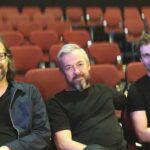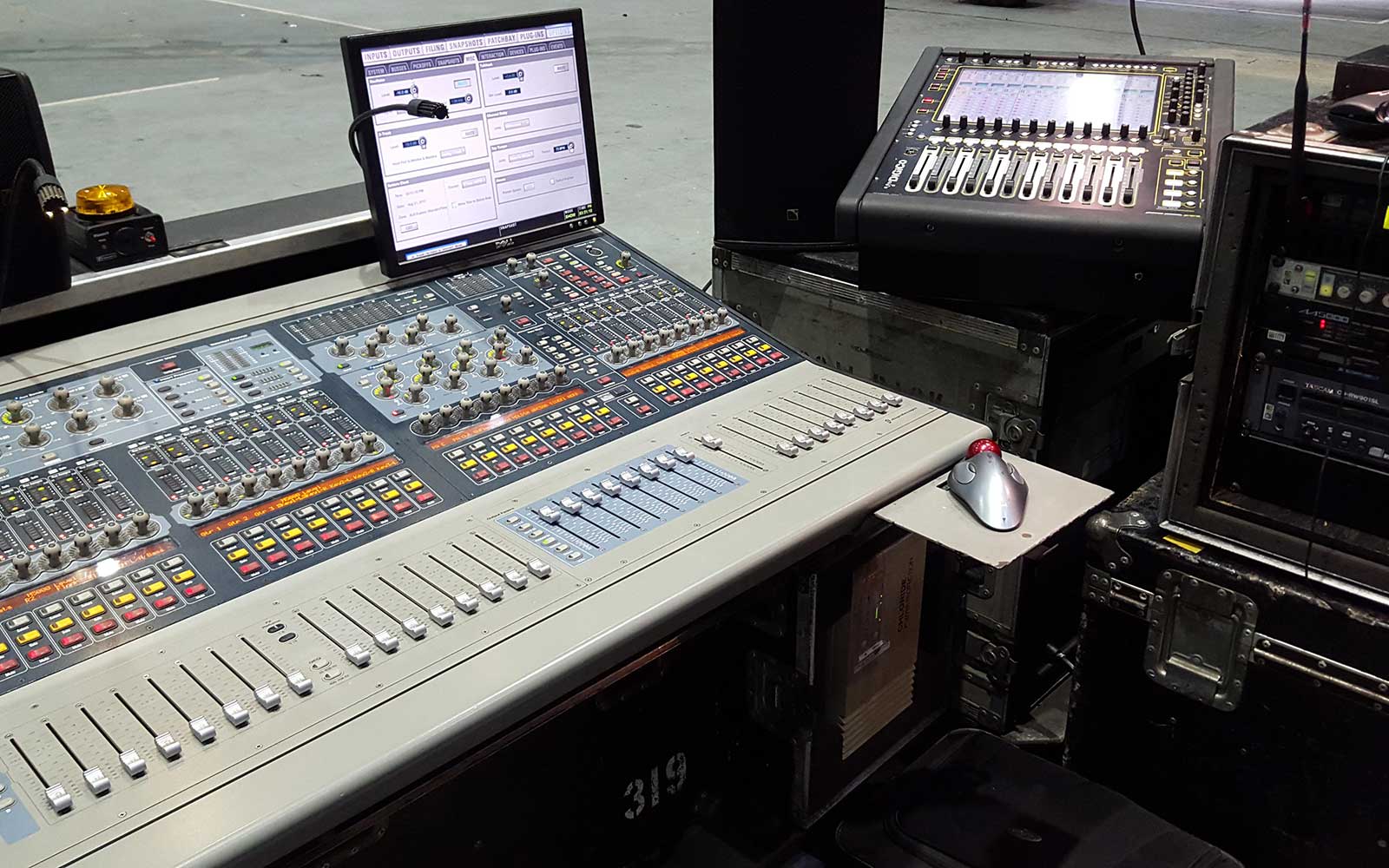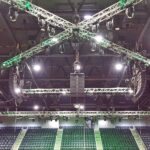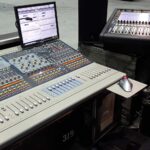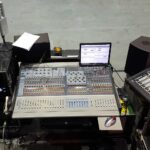
A couple of months ago, Britain’s biggest comedian, Michael McIntyre, returned to Australia with his highly anticipated Michael McIntyre’s Big World Tour.
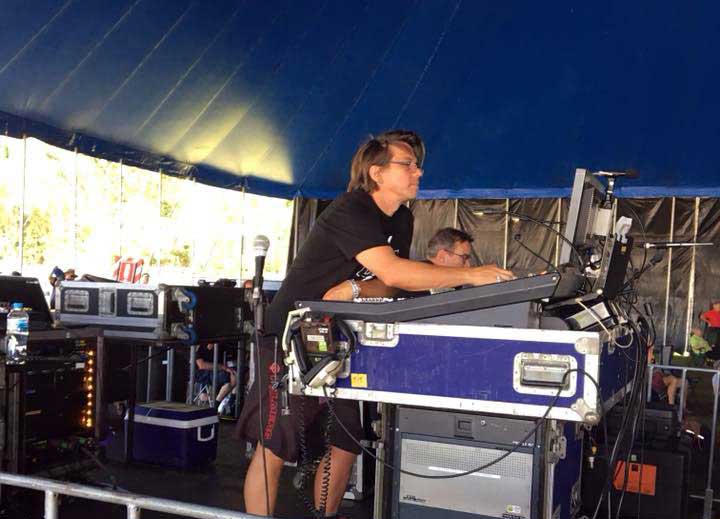
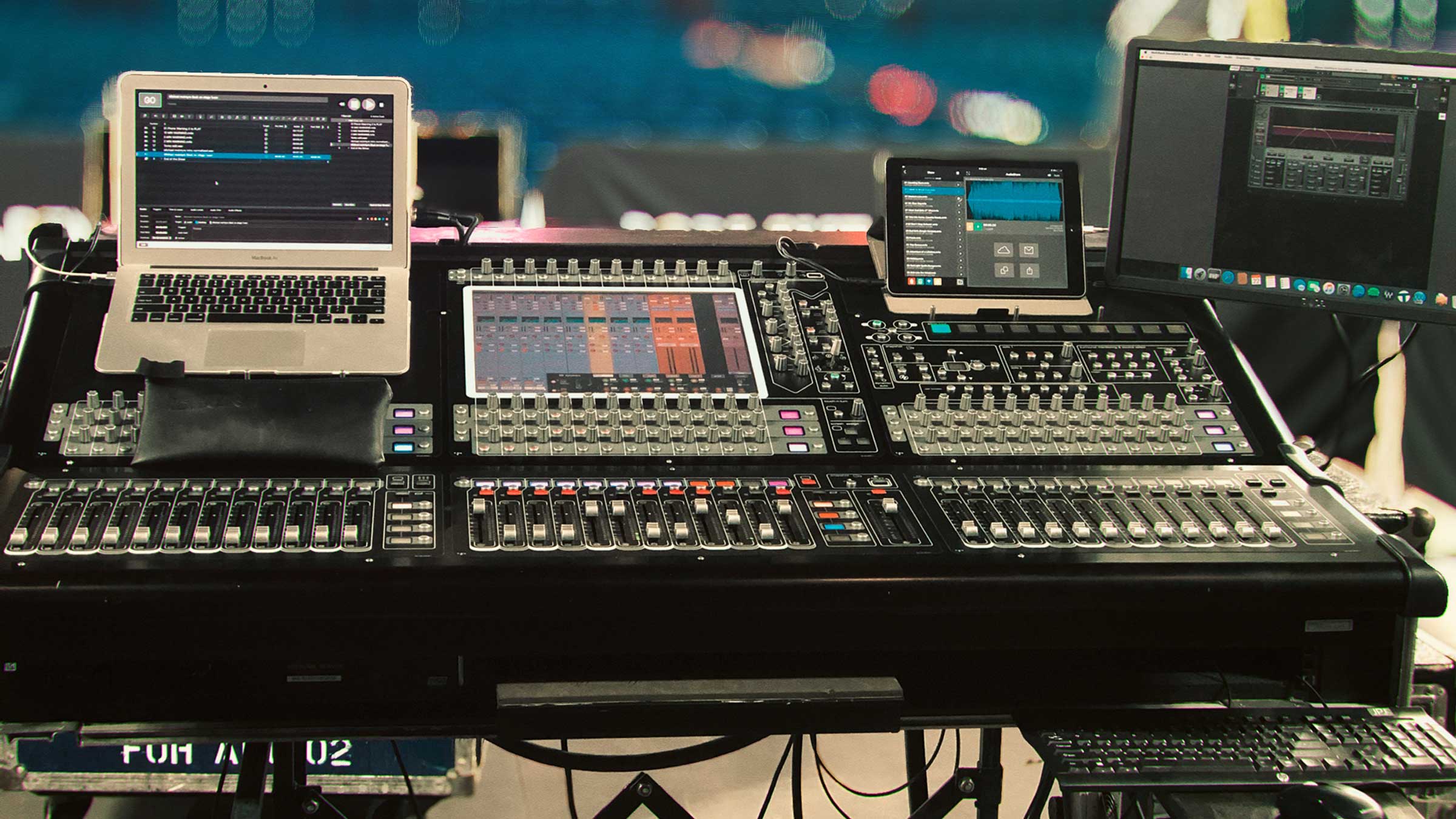
FOH engineer James ‘Oysters’ Kilpatrick was given a short and to the point brief by the artist’s team: perfect high quality audio delivered to every single seat and with that they sent him a Dropbox link to pre-show music, announcements and a pre-programmed cue list!
“Basically it was a case of when in doubt, point a cabinet at it,” said Oysters. “I think it’s really a hangover from people not taking a minimal input show seriously. We play houses to nearly 15,000 people, ticket prices aren’t cheap and people expect to be entertained. So I’m with them – do it well, do it right the first time.”
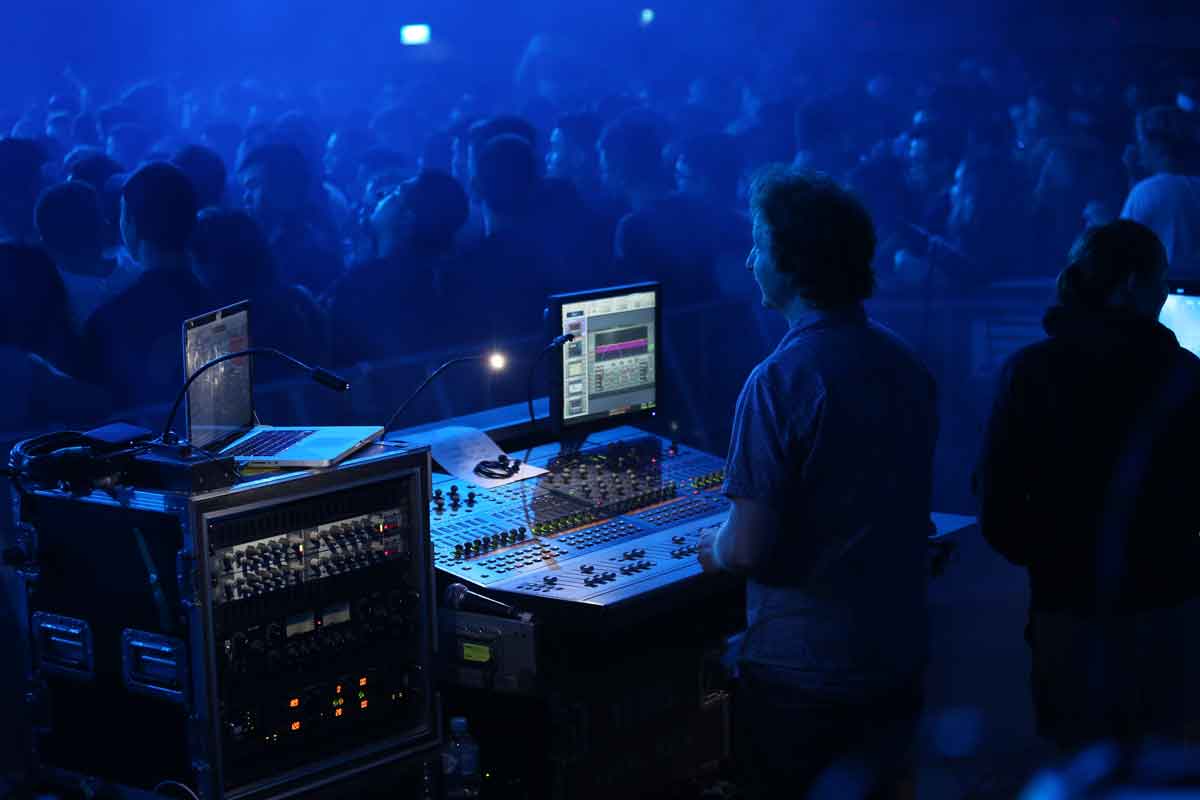
Oysters has a bit of a formula going when it comes to mixing for comedy shows saying he aims for the highest sample rate he can get and staying digital AES for as much of the signal chain as possible.
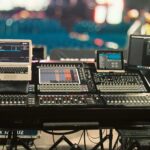
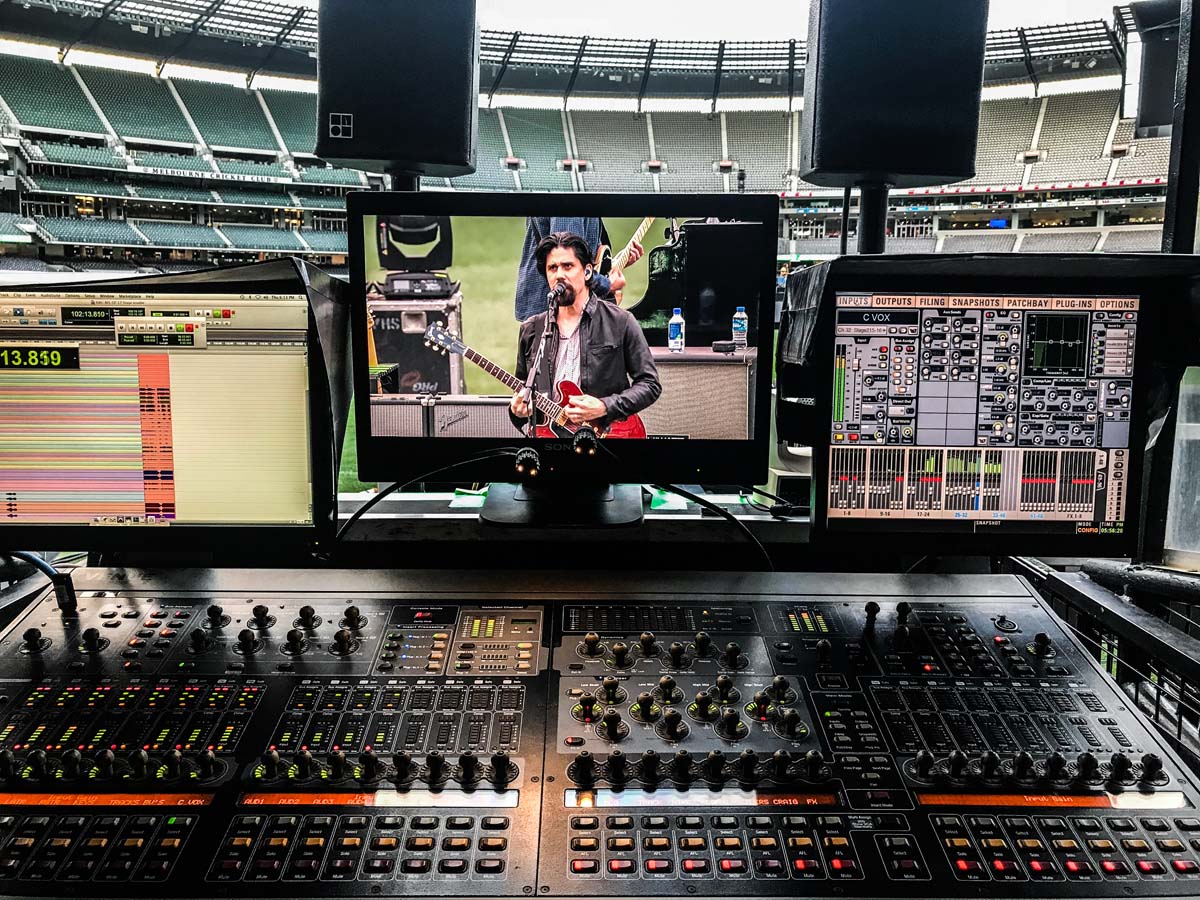
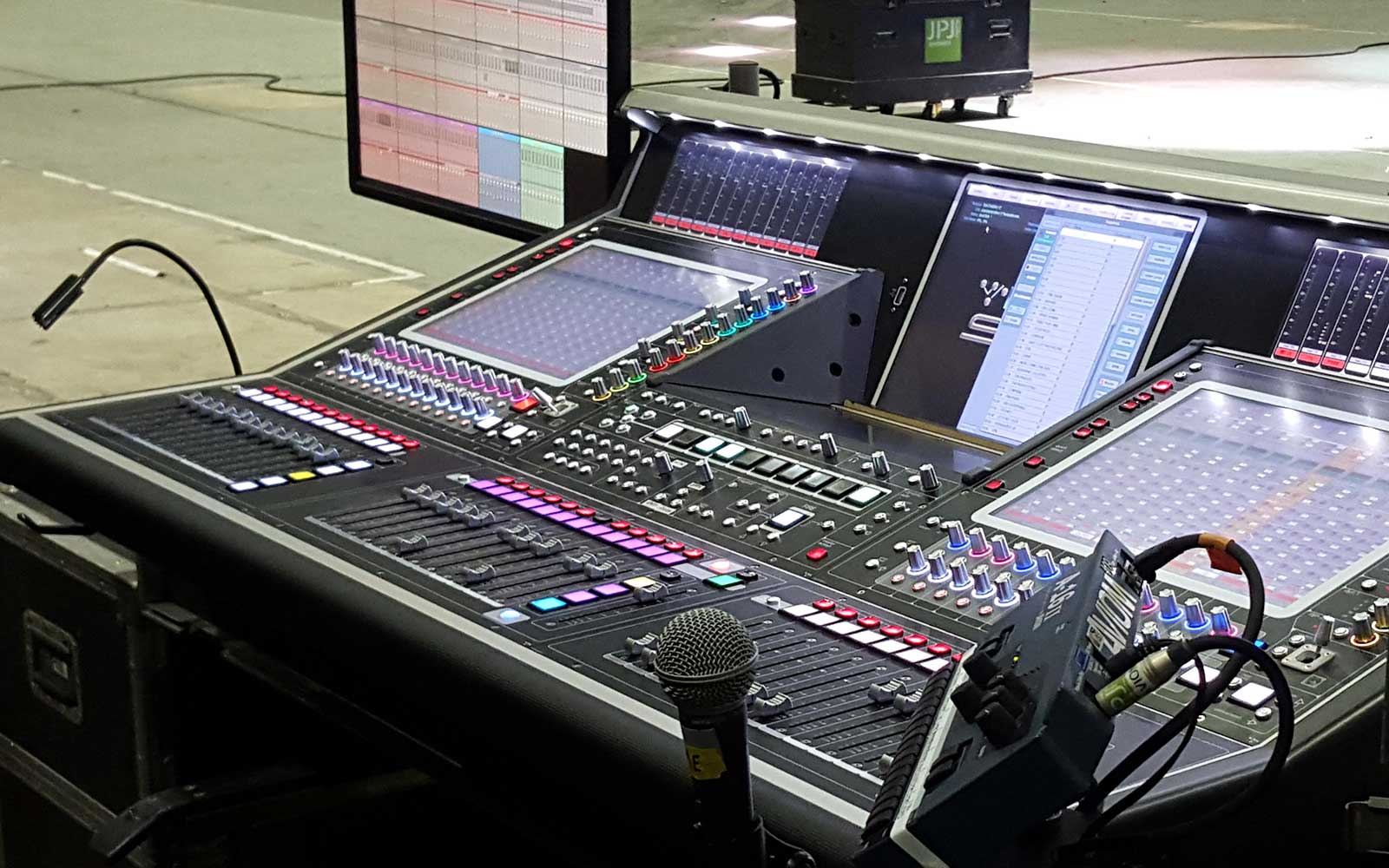
“To my ears it has greater intelligibility for speech and stays smoother, soft and clear,” he added. “I use a DiGiCo SD10 as it has heaps of outputs plus it holds an iPad and a MacBook. It also runs Waves 10 which has a few plugins I rely on for comedy.”
Along with the SD10 with redundant Waves server and Waves computer running live vocal rider, Oysters also had a C6 and the X Feedback plugin saying it is great for mic rejection.
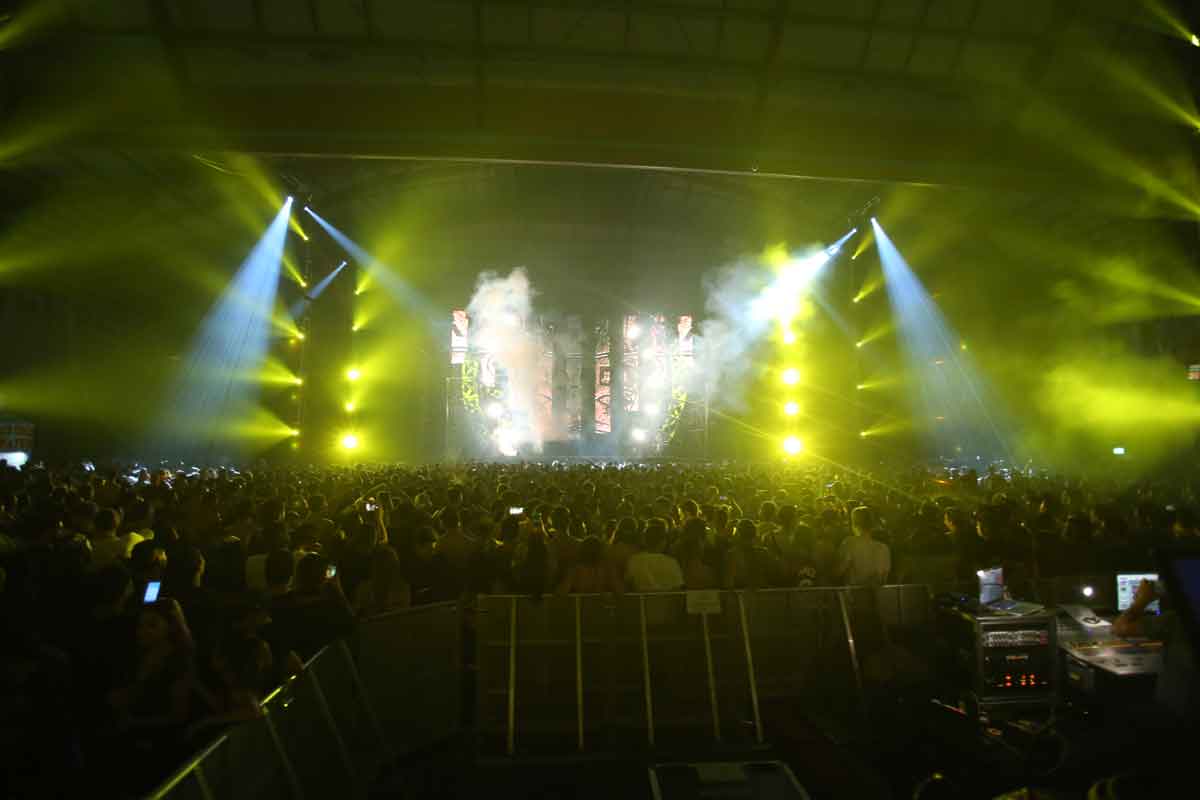
Oysters also ensures there are heaps of speakers saying it’s all about coverage and that takes boxes pointing at people. It may sound simplistic but when you get into Qudos Bank Arena, it’s a great big daunting space to cover with low level speech.
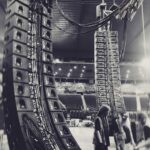
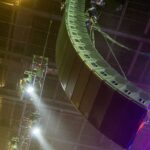
JPJ Audio supplied the Australian tour including Oysters’ favourite PA setup of L-Acoustics K1 and d&b GSL.
“They both throw a soft spoken word a really long way and it lands coherently and legible, no mean feat in a large cavernous space,” he explained. “We typically fly high with a large amount of boxes (12-18 depending on venue) and try to bend the bottom part so it hits just past the front fill but not onto the stage – something the GSL was made to do.”
Oysters concluded that most of his comedy shows have been designed and conceived at JPJ Audio, with rigging plots and cabinet numbers all done well in advance. He notes that the expertise they bring to the table is invaluable and an essential factor in a show’s success.
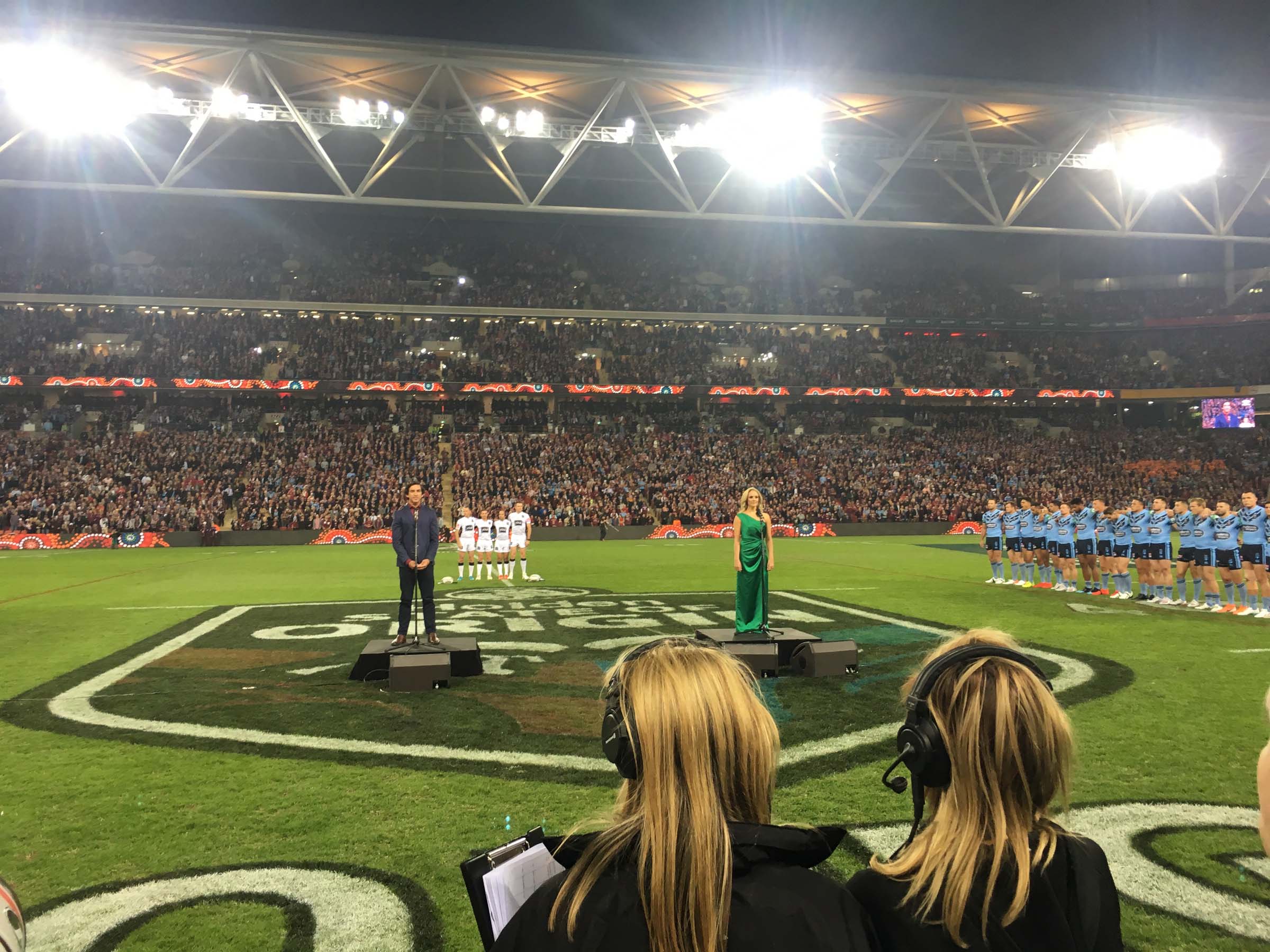
JPJ Audio have had a long affiliation with the NRL and supplying an audio solution for all their major events.
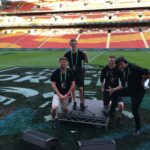
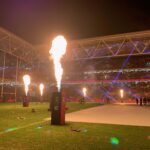
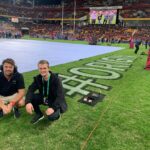
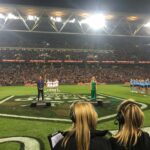
Wednesday night saw the first of the State of Origin 2019 games and the new role JPJ now play in helping the NRL deliver major events.
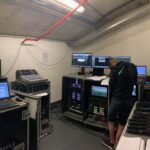
As well as all things audio for game day and pre show entertainment, JPJ now supply the signal distribution backbone for all game day and pre show elements as well as all the coms required for this major event.
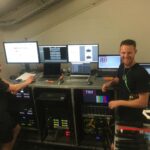
Account Manager and System Engineer for the event Wayne Mulder says, “This has been months in the planning, and I’m over the moon with the result achieved by JPJ and the crew. I really enjoy working with the team from the NRL and delivering great results like this for a valued client. It was a big change from just looking after the audio element, but I was ready for the challenge, and I couldn’t have done it without the JPJ crew behind me.”
Gallery – click to enlarge
JPJ engaged the services of D2N Communications to supply the Hytera 2way Radio solution required for the event, and future games, and it was great working with Managing Director Jason Owen on this event. JPJ use D2N for all our radio needs and can’t thank Jason enough for his support on this.
George Gorga the Audio Director for the NRL mixes the music element for broadcast and pre show element for the stadium and his console of choice an AVID Venue Profile.
For Brisbane, JPJ installed an L-Acoustics KUDO ground PA system to supplement the in house PA. Stage monitors were L-Acoustics 115xt HiQ’s, all radio mics for the show are from the Shure Axient series and IEMs used were Shure PSM 1000s. There was a mixture of Shure and Sennheiser microphones depending on the band’s spec.
Gallery – click to enlarge
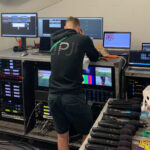
For coms and signal JPJ used their Artist system running 2300 series panels on an AES67 network and rolled out 24 wireless Bolero packs for all the NRL crew on the field. MediorNet was used to move audio and vision around the stadium and interface with OB as required as well as a large amount of Vlans on a Cisco Catalyst network for all the different production suppliers to use as required.
JPJ look forward to working with the NRL on all future events coming up this season and the future.
JPJ Touring Crew for all NRL events this year: Chris Skin, Nathan Todd, Jason Owen
JPJ Local Crew Brisbane: Murray Lewis, Matt Loncar, Dan Charlton, Regan Downes.
WWE, in partnership with TEG Dainty, returned to Australia with WWE Super Show-Down, an historic event that took place at the Melbourne Cricket Ground (MCG) and featured the largest collection of WWE Superstars and Legends ever to appear in the country.
JPJ Audio provided the audio for this prestigious event including a Clair Global Cohesion 12 Line Array PA that was located in the centre of the MCG firing outwards. Also supplied were a flown monitor system inside the ring, all the RF requirements, consoles, patch equipment and of course, an excellent crew.
“The design was based on twelve boxes of CO-12 per hang with two hangs at each corner of the stage,” said Alex McCormack, JPJ’s Crew Chief. “However, despite what appears to be a small amount of boxes, the coverage was great all the way to the very back of the grandstands.”
For the FOH mix there was a DiGiCo SD10 along with a fully redundant SD9. Monitors also used an SD10, added in case there was a live band thrown in at the last minute. Our experience with WWE is you need to be prepared for last minute additions based on the direction of the live event, this set up allowed us to deal with any such situation.
The entrance stage at southern end of the ground featured a ramp down to the ring for the wrestler and host entries. The stage and ramp housed monitors and wedges but no control gear as they were covered by the monitor system.
A full, cutting edge Shure Axient RF system was positioned at front of house with wireless workbench monitored by the FOH engineer and JPJ RF tech monitoring the spectrum. Despite the MCG having significant challenges with multiple TV channels clashing in the middle of the stadium, it ran very smoothly.
“The channel count was kept relatively low compared to what we were prepared for,” added Alex.
WWE’s Lance Vardis did FOH and Clair Global’s Daniel Laveglia executed all of the prep work in consultation with JPJ’s Mats Frankl to ensure a successful event. This was no mean feat as the event was nothing like a typical WWE arena setup.
Despite being held in Melbourne, there was not a single drop of rain during the six days our gear and crew were exposed to the elements!
Xerocon was launched by leading accounting software brand Xero back in 2010 and today is the largest accounting technology conference in Australasia.
It brings together more than 3000 accountants, bookkeepers and financial professionals from Australia, New Zealand and Asia.
“Hailed ‘the Coachella for accountants’, Xerocon has achieved an almost cult-like following amongst the best in the business, so it was essential that Xerocon Brisbane 2018 delivered unrivalled heights of engagement and emotion,” said Laura Roberts, Managing Director of brand communications company INVNT and Xerocon’s event agency.
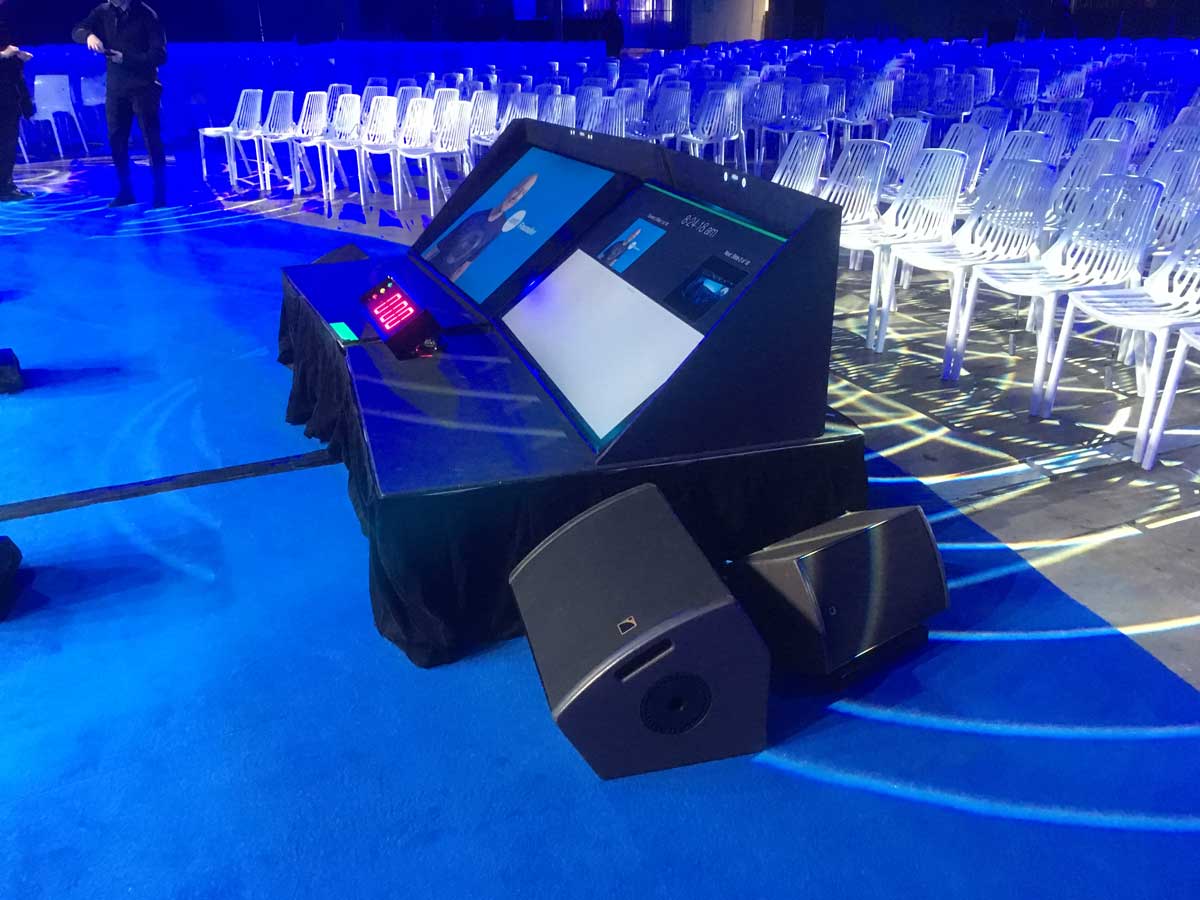
Held at the Brisbane Convention & Exhibition Centre, JPJ Audio were contracted by INVNT and technical directed by Matthew Russell, to supply an audio solution to match the event’s high production values. A solution was required that could cater to the opening act of a high energy DJ to clear crisp intelligible audio to enhance the meaningful and passionate stories told by keynote speakers.
The show was held in the round plenary style and as with most corporate productions, it was imperative that the video screens could be viewed with no obstruction. Fortunately JPJ Audio are very experienced in working PA placement into a video setup and as usual, delivered a successful outcome.
With four massive video screens forming a cube above the round stage, a neat and tidy PA system was required so as not to interfere with the visuals. Eight hangs of nine L-Acoustics dV-Dosc were deployed all in a left/right configuration at each corner.
It was planned to add L-Acoustics dV-SUBs to the PA hangs but weight restrictions on the roof were severe and so the subs were placed under the stage.
“We had twelve SB218 subs in a circle to get a nice wide rumble and big sub feel for when the content had low end in it, just to help get the crowd pumping,” added Matt Morrison of JPJ Audio. “We also had twelve L-Acoustics 108P around the stage for front fill. Originally the client wanted them underneath the stage with the subs so they were hidden but a solid fascia was added to the set which meant you couldn’t hear them! We redesigned the system by placing them around the video monitors onstage to cover the first few rows. It all looked neat and tidy in the end and of course, sounded great.”
Control for the plenary system was on a compact yet powerful Digico SD11 operated by Gary Flemming.
During the day the venue was broken into six theatres, one used the plenary control whilst the others all had their own small control system, three with Soundcraft Si compacts and two with Yamaha O1V96. These all fed The PA People who provided silent-disco PA systems.
“The PA People handed FM receivers out to everyone and set up an FM control which we plugged in to and that’s how all of the breakouts could go at the same time,” explained Matt. “Everyone in the crowd had a receiver into which they could punch a pre-set frequency to listen to whichever breakout they wanted. It was a great little system.”
With audio, lighting and video all competing for weight allocations, this was no simple project but JPJ’s experience shone through.
JPJ Crew:
Tim Seconi, Will King, Matt Morrison, Daniel Charlton, Matt Debien.
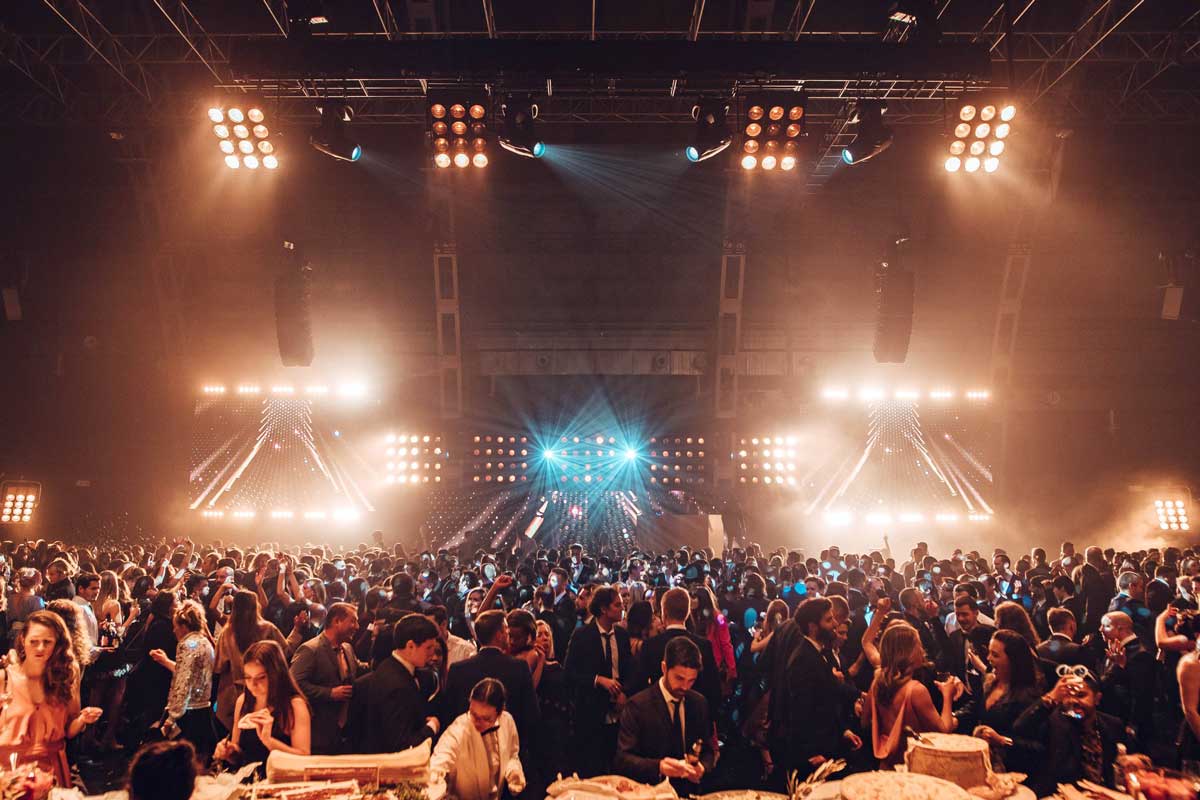
The Merivales (the Merivale Company’s Internal Awards) brings together some of the leading hospitality personalities in Australia to highlight success within the Merivale business. It’s an evening charged with the electricity of celebration, decadence and communal spirit.
The 2018 Merivales was held this year at Fox Studio’s Stage 7 with JPJ Audio working closely with Bailey Holloway, Group Production Manager for Merivale, to ensure a successful event. The night comprised of speeches, DJs and a traditional Japanese drumming troupe.
Fortunately Stage 7 is a very well treated room – well it is a sound stage after all – which benefited FOH engineer Will Krienke who remarked that the production was fairly simple in terms of time alignment.
“It wasn’t like a standard show where you’re mainly taking care of a band,” commented Will. “It was the same amount of priorities but applied to making sure the client was satisfied with the flow. It was seamless from beginning to end with no changeover or down time.”
With the back of stage exposed, including dimmer racks, and high bay lights used, the theme was set for an ‘industrial’ feel to the night.
“We used an L-Acoustics KARA system which is a smaller box but it worked out perfectly for this job as there was no band and we were throwing on the short end of the building,” said Will. “We had nine KARAs per side over four SB28 subwoofers and ARC outfills. We had also had 108Ps around the stage for front infills. As simple and standard as it was, the main obstacle was making it look good as the client was very concerned with the aesthetics of the room.”
At FOH Will ran a DiGiCo SD11, the perfect size console for this job, using solely onboard gear as he only had ten inputs.
Shure radio microphones were used for the speeches with DPA d:vote 4099 added specifically for the drummers.
“They’re just more musical as far as wireless is concerned,” said Will. “They’re full range and great for drums and all sorts of percussion.”
The entrance to the event featured a small L-Acoustics 112P PA which was driven wirelessly with a Sennheiser in ear unit.
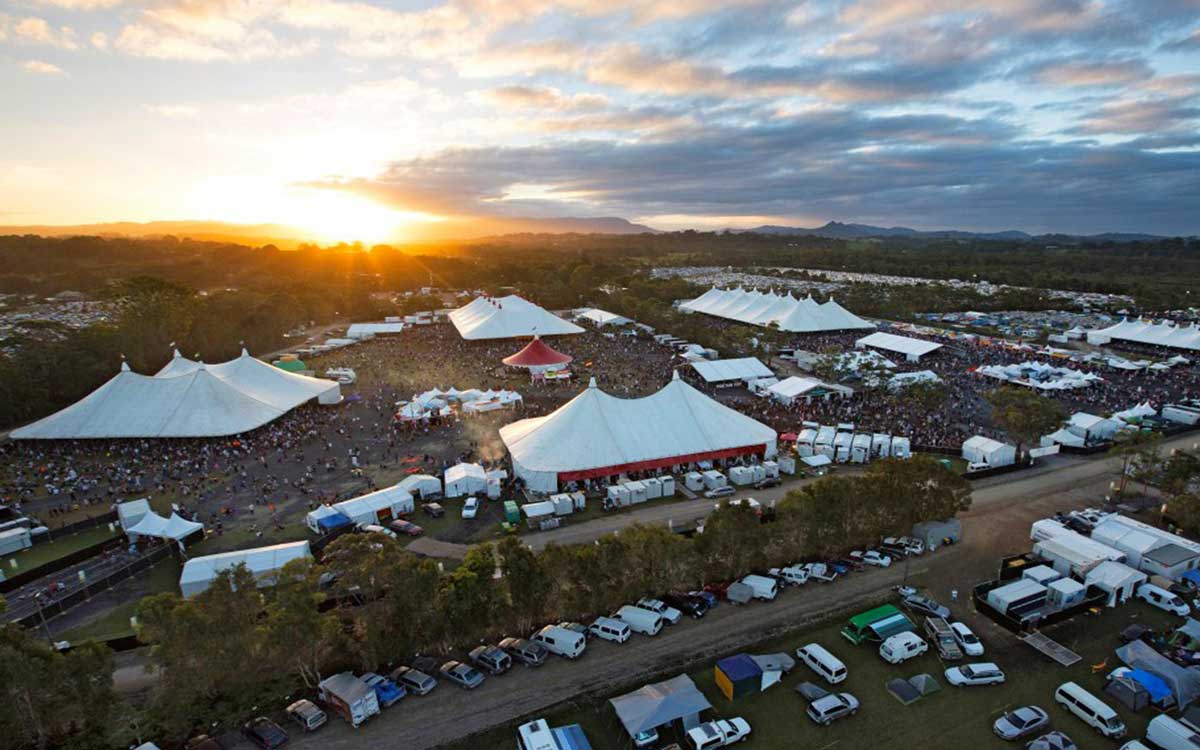
Byron Bay Bluesfest 2018 was on again this past Easter long weekend with a legendary scope of local and global musicians across the five stages including Tash Sultana, Ms. Lauryn Hill, John Butler Trio and Lionel Richie.
As in previous years, JPJ Audio provided a complete audio solution for the three main stages Mojo, Crossroads and Jambalaya. Mojo and Jambalaya had L-Acoustics K2 PA’s whilst Jambalaya had an L-Acoustics Kudo system.
“Mojo and Crossroads are almost identical tents and the PA’s we set up are identical too,” said Tristan Farrow, monitor engineer for the Mojo stage. “We have a systems guy who makes sure they mirror each other and there’s some consistency between the two. Jambalaya is a different beast altogether as they don’t have the A/B system of control that the Crossroads and Mojo have, they just have the one set of control consoles, one FOH console and one monitor console.”
The week before the festival load in, JPJ begin prepping the gear in their warehouse but planning starts a month before when information from the bands starts coming through.
The two main stages have an A and B system so there are two FOH consoles and two monitor consoles which means upstage line checks can be done with one whilst the FOH engineer can be loading show files on the other.
“It helps the half hour changeover time between acts to run smoothly,” added Tristan. “Of course in this day and age everyone wants to have their own equipment and that’s one of the main challenge faced every year by the JPJ crew. Some bring the whole package and some a little bit of their package, or they want us to provide a console for their sole use on the site.”
However most acts don’t require much special attention, they just need to be shown where the power is so they can set up and have the talented JPJ crew on hand to facilitate whatever they need.
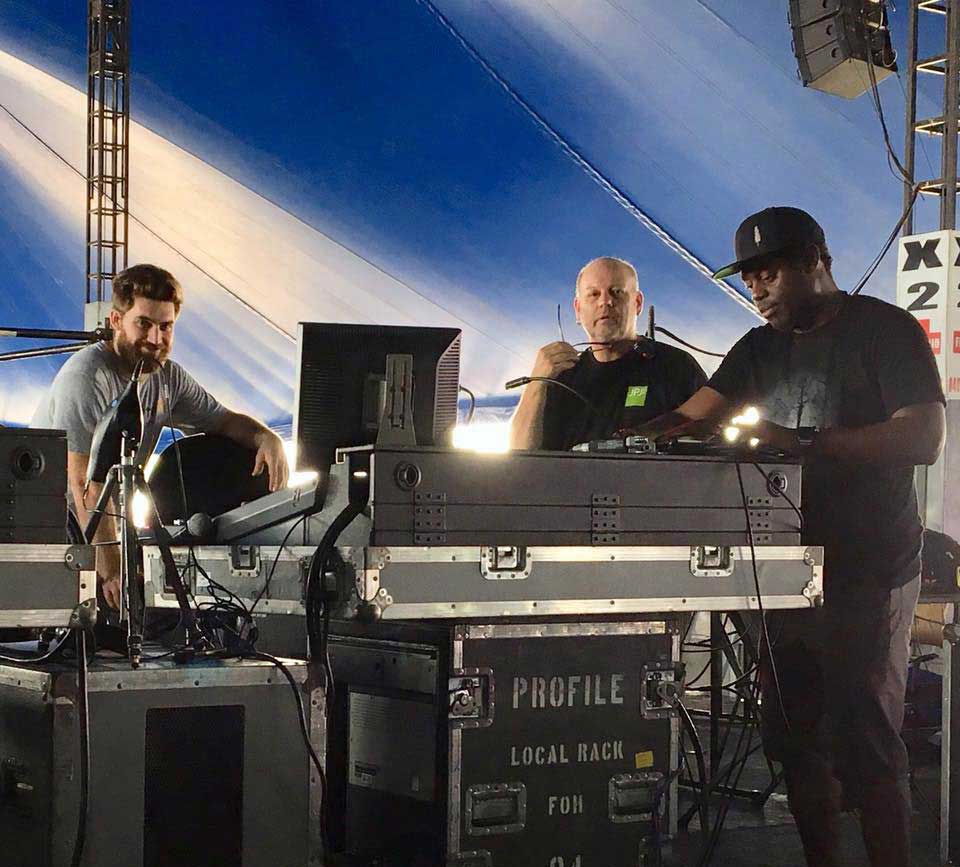
Festival consoles this year were all Avid Profiles for FOH and Yamaha PM5D’s for monitors, on top of those there where a few floating DiGiCo SD7, DigiCo SD10, and Avid S6L consoles.
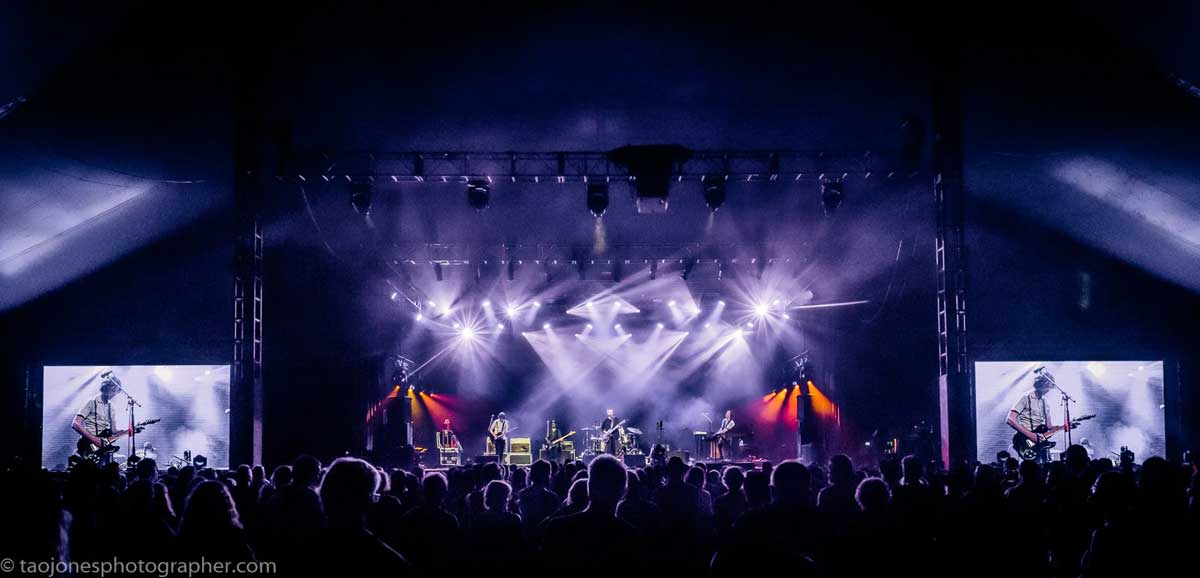
The venues may be tents but Tristan says that they can achieve spectacular results with the L-Acoustics K2 system.
“The K2 is great for this as it has a generous dispersion and the noise limits on the site allow us to have a good rocking band mix,” said Tristan. “The aim is to have every engineer walk away smiling thinking that was a great show. And there’s no reason not to be able to achieve that at Bluesfest.”
FOH Alex McCormack
Monitors Matt Debien
Stage Joel Larson
Stage Marlon Dunn
(Missing was Blues fest regular Brendan Kean due to illness, 1st one he’s missed)
Jambalaya Crew
Stage Ryan Fallis
Stage Will Krienke
(Bluesfest employees for FOH and Monitors)
Ten years on and Michael Waters tells a different story
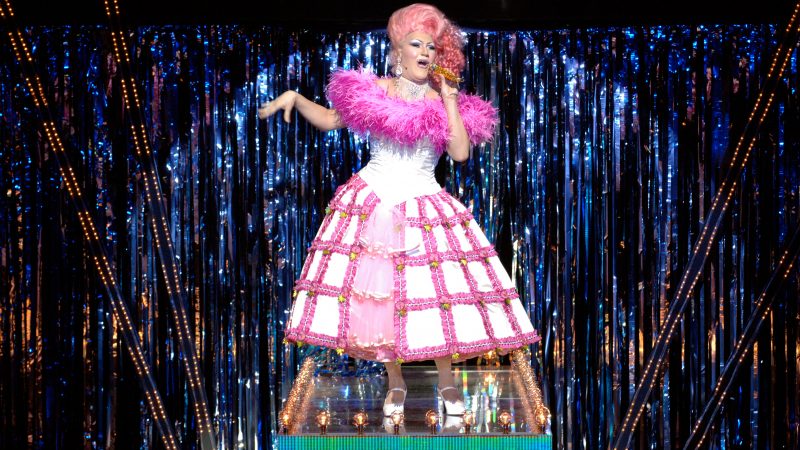
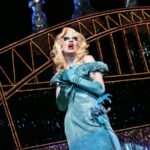
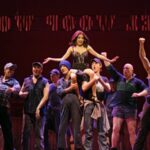
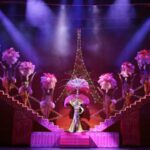
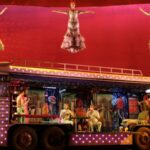
After winning a glittering array of international awards on Broadway, the West End, Europe and Asia, Simon Phillips’ spectacular production Priscilla Queen of the Desert has returned to Australia for its 10th anniversary celebration tour.
Opening at Melbourne’s Regent Theatre, the show is set to tour the country over the coming months with all audio supplied by JPJ Audio.
Sound designer Michael Waters created the original production over a decade ago and since then he says that the evolution of digital technology is clearly the biggest change.
“We started with a digital platform of a Yamaha PM5d but since then I’ve moved onto a DiGiCo system which makes everything a lot more flexible,” he commented. “It sounds great and combined with the Aviom system, it makes it all streamlined. The progression of the networked L-Acoustics amplifiers has made a big difference too. Ten years ago we were using Crown 5002 amplifiers which sounded awesome but everything eventually had to move into the digital realm. Having the flexibility of networked processors, coupled with remote control accessibility via my iPad, means I can wander the building and mix off my iPad. We didn’t have that technology at our disposal back then!”
The Stealth Core 2 infrastructure with the DiGiCo means there is a lot more processing available on their consoles. With the SD10 that Michael uses, he goes direct from the DiGiCo system, from the SD rack straight into the LA8 amplifiers – basically cutting out a drive system.
“A lot of the system processing is done on the console itself, which in turn is controlled by the iPad,” he added. “I have complete flexibility in control of the sound system including the mix itself just from the one app. There is also processing going on with the LA8s and that’s also controlled from the iPad via Network Manager.”
Michael is still using an L-Acoustics dV-Dosc PA system, describing it as fantastic, with the configuration used at Melbourne’s Regent Theatre very similar to the original. The only difference is the addition of a KARA centre cluster and several more delay subs to ensure the disco beats are everywhere and with even coverage in the huge barn that is the Regent.
“There are quite a lot of L-Acoustics subs in the system – DV-subs on each of the four L/R arrays, SB28’s on the aprons, SB18’s on the Delay Cluster and then spread out in the stalls,” said Michael. “In the dress circle there are Meyer 650P’s and then a pair of L-Acoustics SB118 subs above the mix position in the roof. That way we can keep the vibe jumping along all the way to the back!”
Microphones are still DPA 4066, double mic’ed with a DPA 4061 for the three Queens and also the three Divas who fly through the air. All DPA’s are run on Shure UR-4D wireless systems and Shure Micro Belt packs.
“I had to go with the DPA 4066 because of the amount of head dresses that all require quick changes,” explained Michael. “If we were to use lapel mics on the forehead, they would just get ripped off. The DPA 4066 also allows for a higher SPL which is good as there are so many disco come rock numbers in the show. The only exception is the young boy who uses a DPA 4061 because his contribution is only in quiet scenes.”
Microphones for the band include Shure Beta 52, Beta 91 for the kick, Beta 57 and Beyerdynamic Opus 87 for the toms, and a smattering of Audio Technica AT4050’s, Firefly DI on the bass and a couple of Coles 4038 ribbon mics on trumpet and saxophone, which sound very warm and smooth in the high end.
JPJ Audio took over designing and operating the audio system for the AFL Grand Final entertainment six years ago and it’s been smooth sailing ever since. This year The Killers absolutely nailed it with an incredible performance that won them universal praise.
For sound designer James ‘Oysters’ Kilpatrick the biggest hurdle is the sheer size of the playing field, which is around 500 metres in circumference, and the fact that everything has to be set up in matter of minutes. Of course, it also has to be taken down in an equally short amount of time.
“We do a rehearsal during the week where it all has to be wheeled out and struck down afterwards, and then we do a soundcheck and out it all goes again,” said Oysters. “We also have a large amount of outputs as we’re driving the TV OB for the music, sending a mix with ambient mics to Triple M plus feeding the ground and the media. It takes us about a week to wire and thoroughly check all of the outputs as there are so many including various mix minus feeds.”
Oysters ran an Avid Profile mainly because he wanted stability and the Waves Plugins to run without the complication of a server but also because of its’ small footprint as space is premium. He also required a console that was capable of running ProTools whilst at the same time, could add markers for memories via snapshots, as the rehearsals are recorded on the Thursday and on the Friday there are more rehearsals running everything off the ProTools to the broadcast truck. The reliability of the Avid Profile was also a major factor in its choice especially as the weather and temperature can be quite erratic in Melbourne at that time of year.
At FOH control with Oysters this year were Tim Millikan and Ryan Fallis, with Oysters sending his outputs to Tim to distribute via matrix mixers, line drivers and active splitters. Everything that Oysters had on his console was mirrored onto Tim’s DiGiCo SD11 in case Oysters console was to fail. Ryan looked after the fully redundant ProTools replay and would also send everything he was doing to Channel 7. All control gear was on a UPS and were all timed, with JPJ doing extensive power failure tests in the factory leading up to the event.
“It was all fibre with Channel 7 directly to me so that was a bit easier than years previously,” added Oysters. “Tim and Bowden Birkett (JPJ Audio’s head system engineer) could actually change any part of the PA or any part of the zoning, or even the levels to Channel 7 without asking me.”
It’s important to remember that this is a TV show, not a concert, which can be a hard thing for people to get their head around. It’s not only live in the ground, its going live to millions people, there is no waiting till somebody is ready, it just rolls ready or not.
“You have to use wind socks as it’s our windiest month in Melbourne and it really swirls around the ground,” said Oysters. “RF can also be a problem and in the past, it has failed. This year Frontier production bought in Peter Cochrane from ARTICULATE Communications to manage all of the RF and communications. He lowered the power on all of the radios, allotted all of the frequencies and it worked incredibly well. Everyone is on in-ears because without them the amount of slap back in the playing field is disorientating.”
Sixteen carts of d&b audiotechnik cabinets were wheeled out, each cart holding three d&b J Series cabinets.
“The ground runs in mono with redundant loops of signal and power so the most you could lose would be two or three carts,” said Oysters. “We can even broadcast for about 15 to 20 minutes without power although the speakers would fail. We could have run it with fibre but that would have got quite complex and I try to keep it as simple as possible, especially as so many complex things have failed at this event in the past. Eventually it will be entirely networked but when we do that, we’ll probably run it in the shop for a month before.”
Oysters remarked that this years’ show by The Killers was the best yet, even though the band was so complex he didn’t take a full split of all of their gear.
“As they have so many electronics such as sequencers, synthesizers and keyboards, we had that all bussed down a series of stems by Marty Beath,” he explained. “We took the vocals, guitars and drums all separate but it was condensed across sixteen lines instead of say fifty-six.”
Once the footy had finished, The Killers performed a free show for anyone who wished to attend reverting back to a normal concert set up with FOH and monitors and with Oysters looking after OB to television only.
Thousands of performers and spectators converged on the WIN Entertainment Centre last month, as the annual Southern Stars school arena show hit town.
More than 3000 student from primary and high schools in the southern schools region performed with the show also including soloists, a 500 piece choir, and orchestra and an indigenous dance company.
Students came from about 120 public schools as far away as Bourke, and the show was touted as the biggest show so far in Southern Stars’ 17-year history.
JPJ Audio provided all things audio with a system designed Bob Daniels and implemented by George Gorga whose biggest challenge was a large orchestra mainly comprising of students!
“It takes them a while to get used to being in the arena dealing with headphone monitoring, IEMs and the PA running but there’s a point, usually around dress rehearsal, when it all comes together,” he said. “I’m also dealing with a large number of non-professional vocalists but again, it all comes together in the end. Having said that, the musical standard of these kids is extremely high and during the public shows it’s easy to forget that some of these players and performers are only in primary school.”
The stage is set traditionally at one end, albeit a bit bigger than a standard stage, and primarily accommodates the orchestra, whilst the arena floor is the main performance area for soloists and dancers. The choir sit in the seating bank behind the stage.
“The PA is a central cluster hung above the floor centre,” explained George. “There are three positions; one facing forward and two straight out to the sides. It looks a bit odd as the centre PA is about two metres behind the side clusters but it works really well and they don’t get in the way of each other. The time alignment is ‘physically’ very close to start with and it’s seamless when you walk around the room.”
Jack Richardson, system tech for the event, remarked that this is the best sounding configuration he’s had heard in this venue. George admits he had a bit of an advantage in the fact that he only had to cover the seating from a centrally located PA, but insists a lot of the success was down to Bob Daniels’ design.
“Of course the L-Acoustics K2 system is amazing too,” George added. “It’s my favourite system at the moment. This is the first time we’ve used the K2 on this event and it was a real leap ahead in quality and impact.”
FOH George ran an Avid 96-channel Profile console plus a 48-channel DiGiCo SD11. On the Profile he used just about all of the available effects adding his standard TC Electronics M5000 reverb and a Smart C2 compressor over the mix buss.
“I use those pretty much all the time and although I could use a plugin for the C2, I’ve got the real thing and it just holds everything together in the mix,” said George. “In a situation like this show where it can be quite unpredictable, the C2 can be a life saver.”
Radio microphones were twenty-six systems of Shure Beta 58 with a couple doubling up as guitar packs and DPA 4088 headset systems. Orchestra microphones were assorted with George favouring dynamic microphones such as Shure 57 and 58’s for brass and woodwind.
“In this situation, they’re much easier to deal with when you have kids using them,” said George. “I still get the sound I want without using expensive condenser mics. With the constant turn around, the radio mic tech Bianca Martin and her volunteer student crew are kept very busy!”
Monitors were taken care of by Bob Daniels on a DiGiCo SD5 with an Aviom headphone system for the orchestra and lots of Sennheiser IEM systems for the singers.
With the express purpose of uniting the Trance scene, creating memorable experiences and spreading the love of Trance, Istoria made its’ debut at Melbourne’s Margaret Court Arena followed by a night at the Sydney Showground Halls.
JPJ Audio supplied the equipment for both events with a d&b audiotechnik PA used in Melbourne and an L-Acoustics PA in Sydney.
Operating both shows was Josh Barker who stated that nice even coverage, with a little bit more bottom end, is always a good starting point.
“Dealing with a dance party, it’s obviously about creating a good level on the dance floor without blowing the windows out when you open the doors!” he added. “Also, you don’t want it too fatiguing for those listening to it for eight hours at a time …… and that includes me!”
Josh commented that he prefers the older L-Acoustic boxes for dance parties adding that the V-DOSC works very well having two 15’s in the mid high cabinets.
“It helps keep the kick drum very punchy and all the bottom end detail doesn’t get blurred out,” he said. “I’ve worked with this PA for years so I know it very well. It is always very important to get your subs right otherwise you will be hearing from the noise police on the hour, every hour. Andrew Rogers looked after the EPA consulting in Melbourne and the Sydney show was handled remotely, via SMS. Maintaining that LEQ average and leaving yourself some breathing space for the main act is vital! Otherwise the later it gets, the quieter it gets. These events sometimes run until 6am.”
As for mixing a dance party, Josh describes it as almost like remastering the content coming from stage for a big PA in a room or an outdoor setting.
“We are well and truly in the digital era as far as the modern DJ/Producer is concerned. Most of the content has been produced and mastered ‘in the box,’ and sometimes it need some warming up on a large system, especially in the large warehouse style venues. I am making adjustments tailored to each track being mixed in by the DJ. I’m really just taming frequencies and making sure there’s a nice healthy level without hurting anybody’s ears. Being dance music, it can get quite nasty at high volume, most of the synth sounds are based heavily around the square and sawtooth VCO’s and they can really poke out when the PA is at battle-speed.”
Josh mixed on an Avid Profile console with a Waves Maxx BCL as a left and right insert, a Puigchild and some Midas XL42’s for some analogue pre amps on the front end. On board, he used a Waves C6 multiband dynamic which keeps everything in check when his hands are busy doing something else.
“I use the Maxx BCL as the last point in the chain on the output and that’s got a compressor, bass expander and a limiter all in one,” he added. “It’s really good for keeping the level where I need it, especially if the DB limit is undesirable. It allows me to make it sound big at lower levels and maintain the vibe on the dance floor regardless of the restrictions in place. I use the PuigChild over a group to soften things up when I need to without having to bring the level down. I used this mostly during breakdowns/build-ups when things can get very busy and you generally don’t have a lot of bottom end to round it all off.”