Blog

  • Maroon 5

    Maroon 5 2

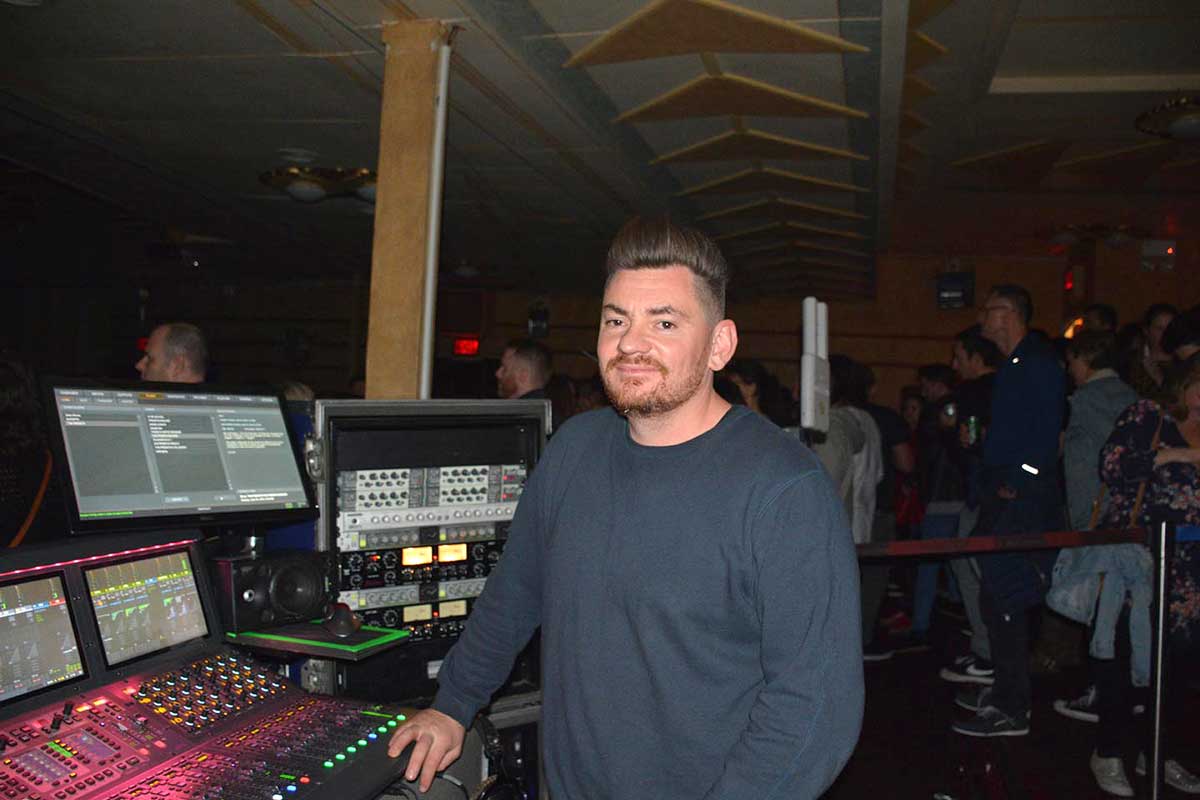
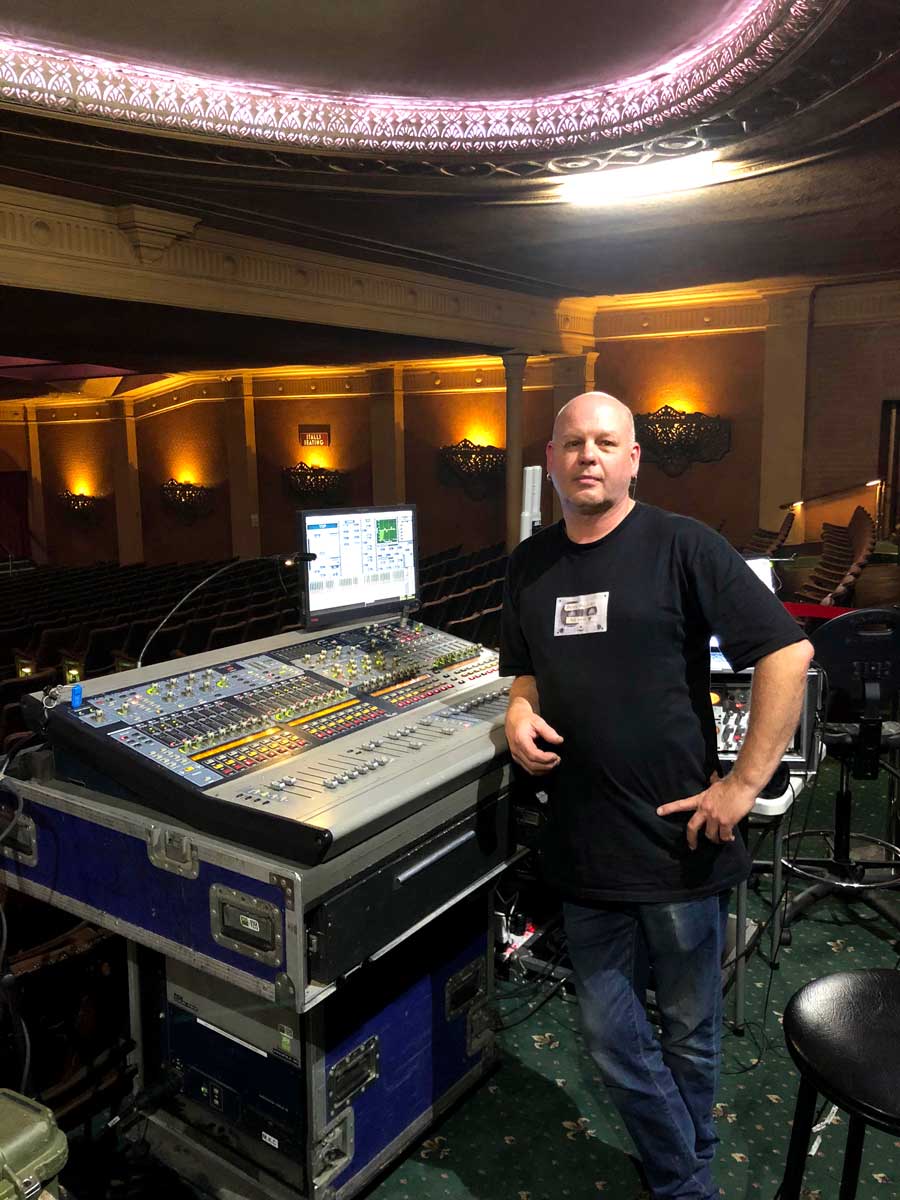
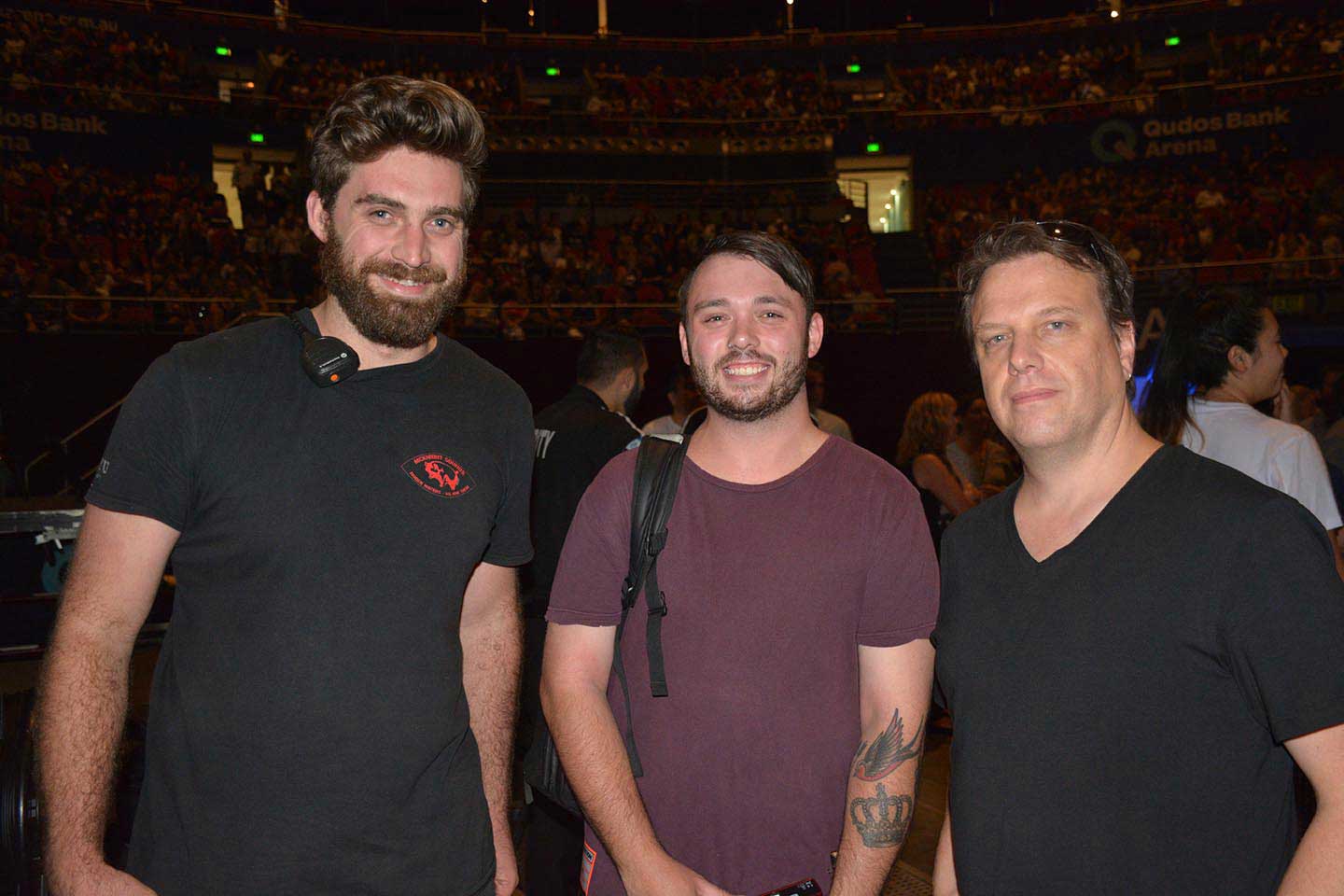
    Photo: Vince Casamatta and system engineer Mathew McQuaid

    Vince Casamatta learnt his trade mixing bands in small, Chicago dives eventually expanding to going on the road. At the same time he had his own studio and truthfully, he always wanted to be a studio mixer.

    But this is just what ended up working out!” he said. “I still occasionally mix an EP or album but mainly for indie artists.

    On the Maroon 5’s Red Pill Blues tour, Vince is the new guy although he has been with them for nearly a year.

    This is one of those camps where people have been around for a really long time,” he added. “I think a lot of people have many opinions on what Maroon 5 should sound like so initially it was challenging to navigate my way through that, but these guys were all very good at giving me space to do my own thing. Although Maroon 5 write a lot of pop-leaning songs, they are very much a rock band and want to be treated as such live.

    Maroon 5 7Vince was clearly enjoying mixing for a real rock band that can all play together without any backing tracks, saying these sort of acts were becoming less and less.

    It’s very much a rock mix that I want out of the gates to grab you and be surrounded in,” he elaborated. “I don’t want it to be a wall of sound that just hits you for an hour and a half. I don’t think anybody enjoys that. I try to find places to work with the dynamics of the musical arrangements and sometimes accentuate them so you can hit hard for a bit and then pull back. These guys are really aware of those things anyway with their set list choices and live arrangements, I’m just trying to present that the best way I can.

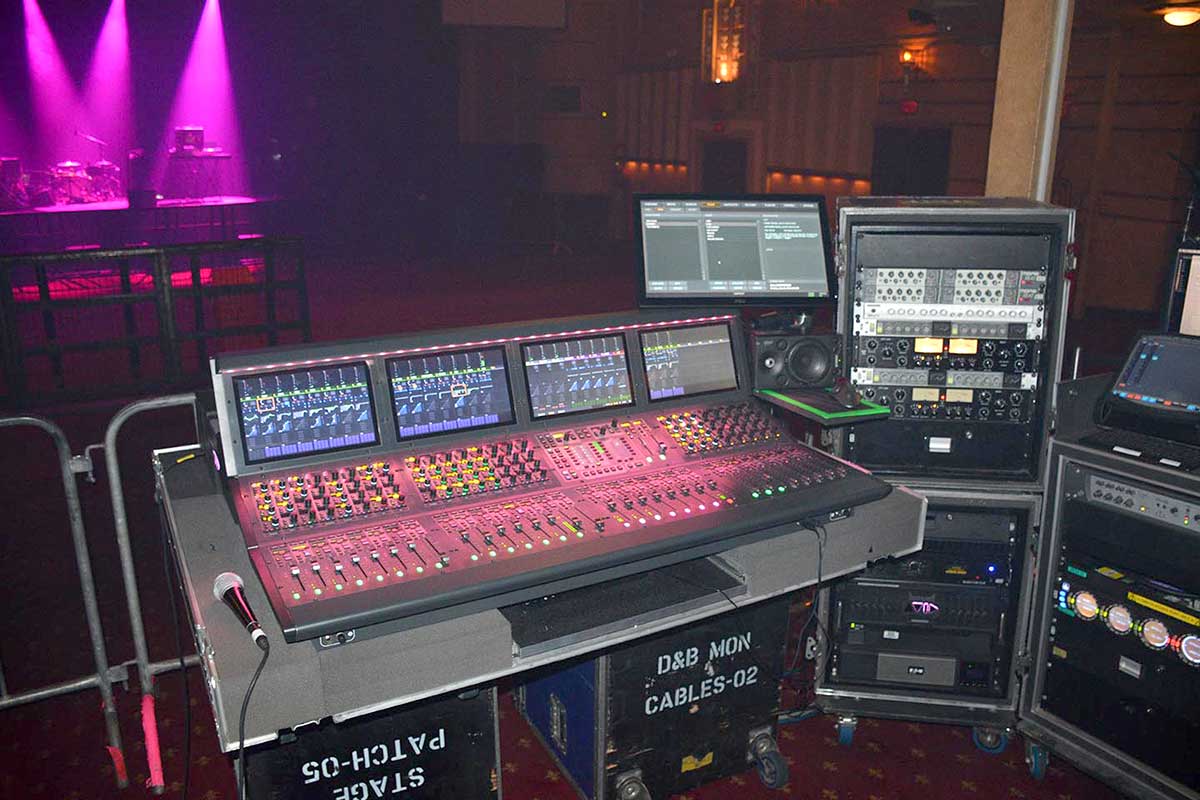
    As a fan of DiGiCo consoles, Vince opted for an SD5 favouring its’ work flow and complexity. As well as some outboard gear, he had a Waves SoundGrid server running up on the SD5, with anything that needs to be automated going on the server and anything that is static for the entire show in his outboard rack. The Waves plugins mainly group compression and parallel compression which gave the mix flavor and texture as the DiGiCo is such a neutral surface to begin with, according to Vince.

    The API 2500 is a great compressor and the SSL Quad compressor is always good to add parallel compression to drum busses,” added Vince. “I really like the API 560 EQ plugin on the kick and snare buss; as it’s a live drummer his dynamic changes throughout the set, and the API 560 allows me to re-tailor how the drums are sitting in the mix on the fly.

    On the road, you don’t know what kind of support you’re going to have so I like to keep things as simple as possible so if things go wrong, you can troubleshoot them easily,” he said.
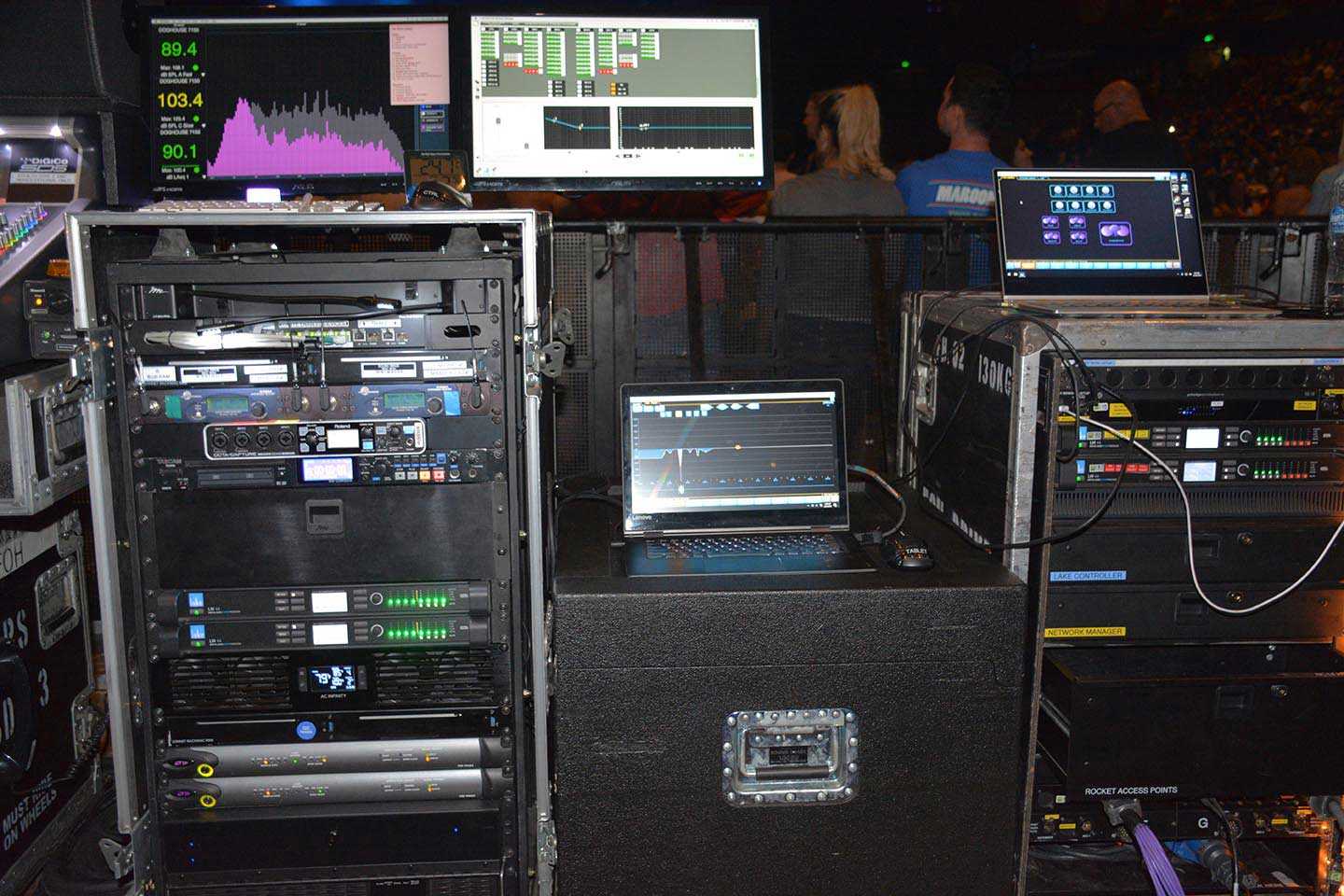
    Maroon 5 6Outboard gear included a Bricasti M7 for Adam’s main effect reverb with Vince using Midi triggers from the snapshots to change patches in the Bricasti. A Tube-Tech CL 2A is used for a compressor on Adam’s vocal and spare vocal, whilst a Neve 5045 primary source enhancer saves Vince a few headaches as most of the show designs feature Adam in front of the PA for nearly the entire set. However in Australia the set was scaled back with a design that kept Adam behind the PA!

    He’s always in a different place with respect to the PA, L-Acoustics being so tonally linear as you walk through it is helpful but the Neve 5045 is super helpful,” explained Vince.
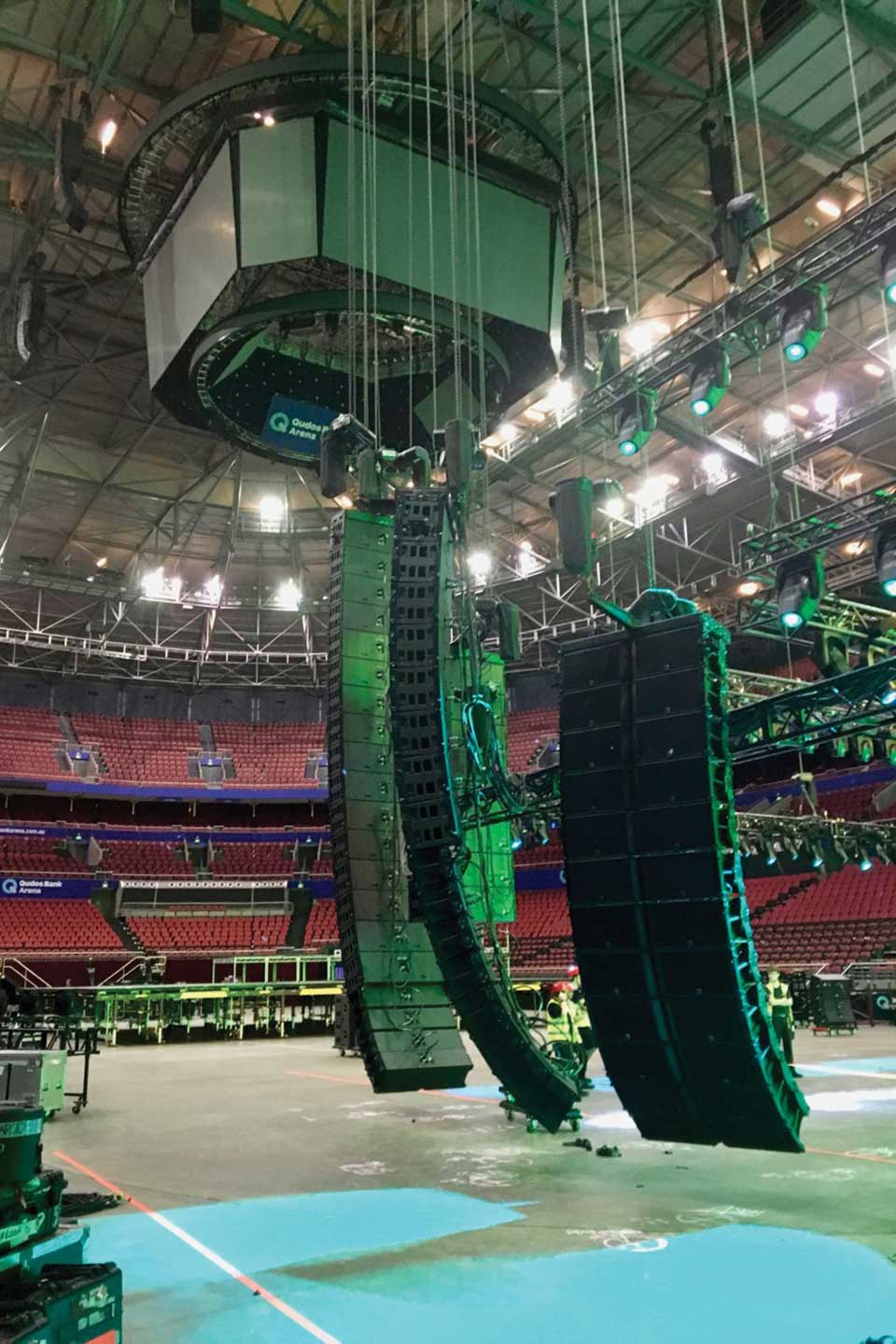
    Maroon 5 5PA was an L-Acoustics K1/K2, K1 main and sides with K2 below with the sub configuration often changing depending on the venue.

    We are flying K1 for main and side hangs with K2 below, so that we keep the coverage consistent close to the stage,” explained Vince. “Rear hangs are almost always K2 only. K1SB are always flown directly behind the main K1 hang for added low extension and punch. We also use a cardioid sub arc on the floor. All powered by LA12x wherever possible. One of our main concern in design is how to keep low end off the deck so the band aren’t rattling around up there. Mathew McQuaid is responsible for overseeing the entire design process and has done a great job of maximizing FOH coverage while nulling the low end on the deck.

    Systems engineer Mathew McQuaid used Soundvision, L-Acoustics’ proprietary acoustic prediction software, and Rational Acoustics Smaart 8 to align the system each night.

    There are a lot of good PAs on the market and you can have a great show with many of them,” said Vince. “This is the most vocal forward mix I have ever had and the L-Acoustics has made me feel like I’m not fighting myself as far as where the vocal sits in the mix. I want a really cool, rock-sounding mix but I don’t want to sacrifice the fact the vocals have to be over top, in fact the vocal presence has been pretty easy to dial in.

    The band are Shure endorsees with lead singer Adam Levine using the Shure Axient system and singing into a black SM58, a no frills approach that Vince admires and although Adam beats the mic and tosses it into the crowd every show, it always holds up.

    It’s the right approach to pick a microphone that is tried and true, meat and potatoes, nothing fancy as he basically uses it for everything but a hammer,” laughed Vince. “With this show, I have been less concerned with microphones than with other acts and I don’t really know why that is. I have the new D12 kick mic, a dynamic microphone that, when supplied with phantom power has a few different EQ curves. I have a 57 on snare top which sounds great, all no frills. If you have a good band with good tones and a great mixing console, a lot of it is just getting out of the way and letting it happen.

    The band changed a lot of the guitars to Fractals from Royer Ribbon mics, which Vince says sound way better and sit in the mix well taking up less headroom. With seven people on stage headroom becomes a real challenge quickly.

    Monitor engineer Bill Chrysler mixed on an Avid VENUE S6L-32D with the latest version of Waves SoundGrid. Most of the plugins he used were in the console, with the exception of Adam Levine’s vocal reverb, which is a Waves TrueVerb.

    Everyone has both IEMs and wedges, except the bass player who has no IEMs and Adam who only has IEMs.

    The wedges help to retain a bit of vibe onstage as stages become quieter and more isolated, it’s a way for the band to feel connected,” commented Vince.

    JPJ Audio supplied the tour.
    Maroon 5 4

    This article first appeared in the print edition of CX Magazine April 2019. CX Magazine is Australia and New Zealand’s only publication dedicated to entertainment technology news and issues. Read all editions for free or search their archive www.cxnetwork.com.au
  • Florence + The Machine

    Florence Machine 1

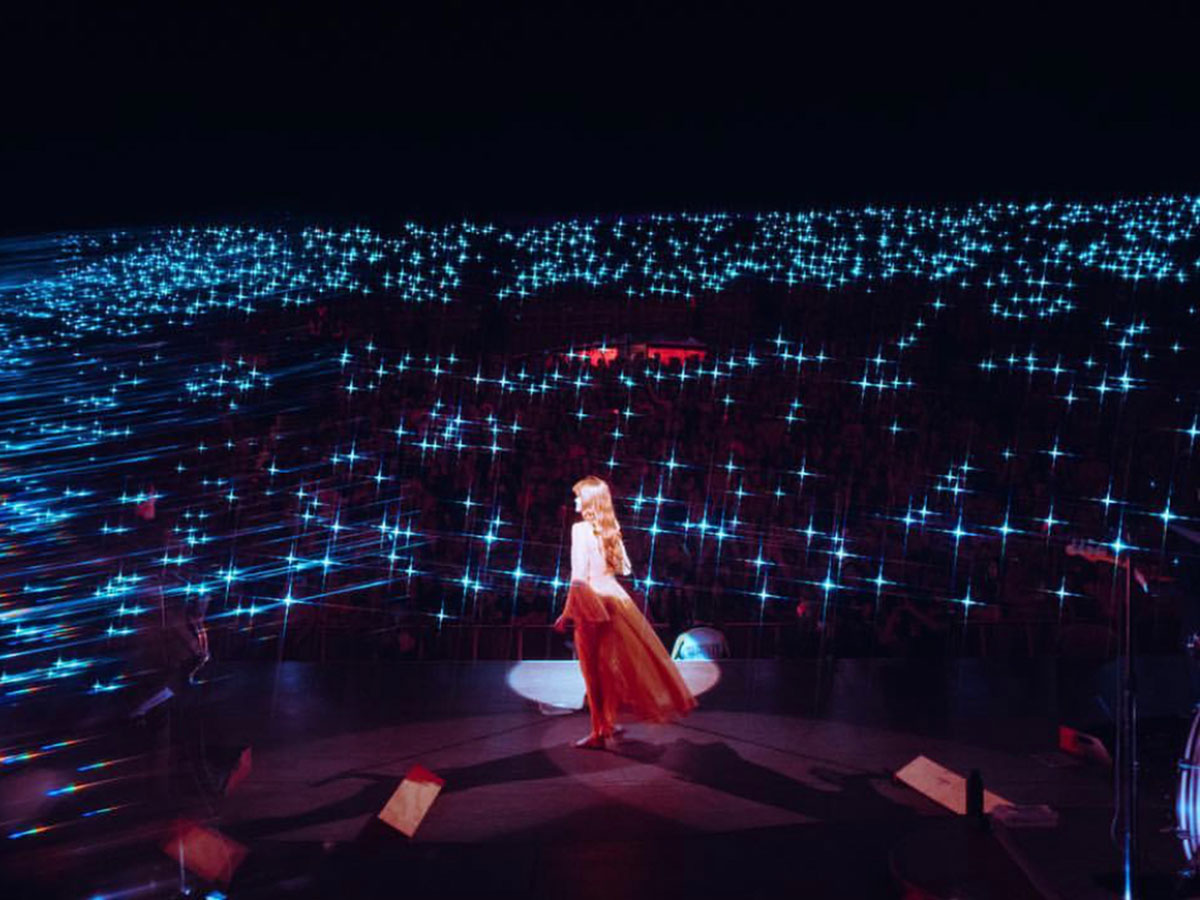
    Florence + The Machine returned to Australia in January for a string of national headline dates. Having released their fourth album, High As Hope, just last year, fans were clearly eager to catch these stunning tunes live, with almost every show on their Australian tour having sold out months in advance.

    FOH engineer Brad Madix is currently on his first tour cycle with the band having started rehearsals last March. Brad, an award-winning, Grammy-nominated live, broadcast and recording engineer, has had an illustrious career working with artists such as Linkin Park, Rush, Jack White, Beck, Van Halen, Shakira, Alanis Morissette, Jane’s Addiction, Shania Twain, Def Leppard, and many more international acts.

    Florence Machine 2

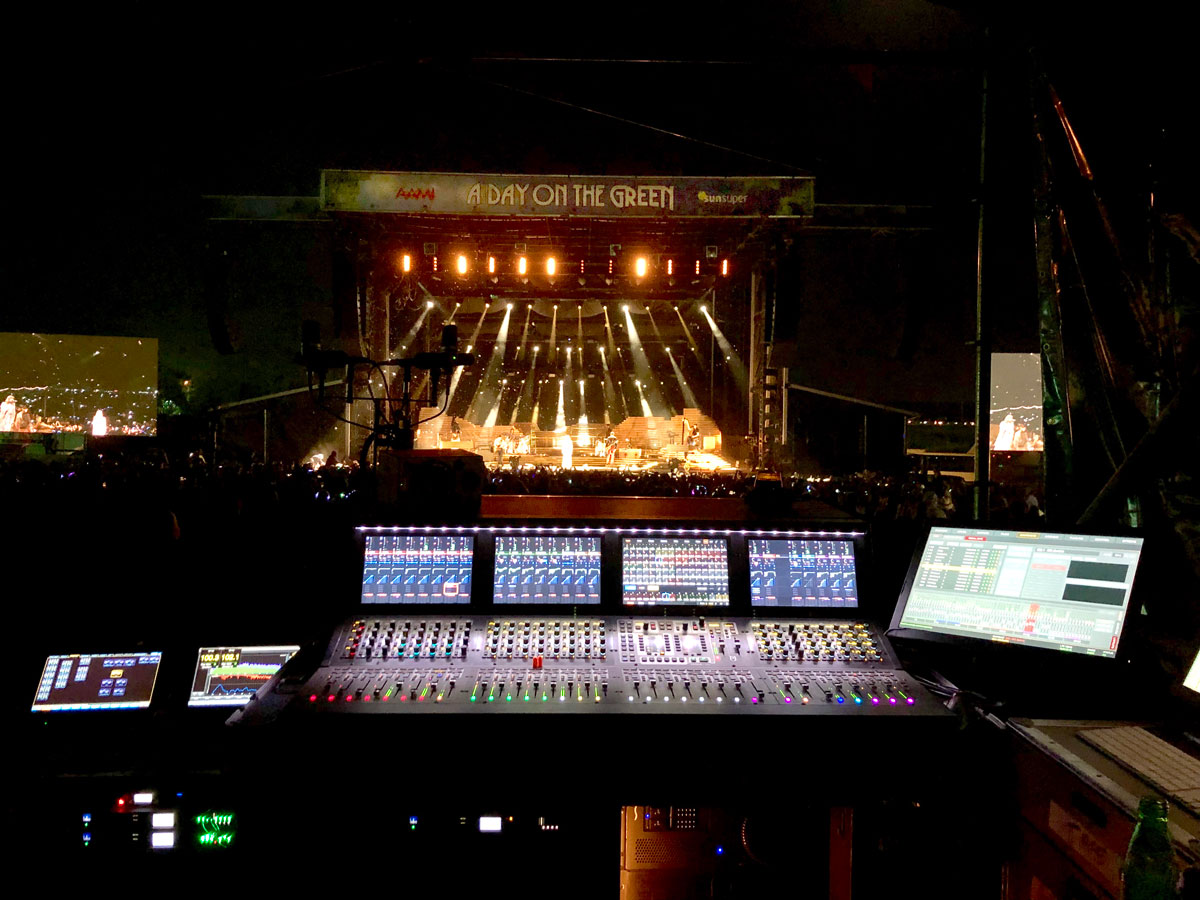
    JPJ Audio were the audio supplier with the tour utilizing a Clair Cohesion Series PA assuring uniform coverage in all venues regardless of acoustic challenges or sightlines. This was certainly put to the test in Australia with the show being held in arenas, outdoor venues, as part of a festival and also a Day on the Green.

    I would say a typical set up would be 16 x CO12 deep, left and right, and then six subs per side with 12 CO8s for outfill,” said Brad. “However, that changed day to day on this tour due to the variety of situations we were in.

    Brad describes the Clair Cohesion Series as simply a great sounding PA, from top to bottom, that provides really nice clarity and is easy to put up.

    I’m very happy with the sonic characteristics of the Cohesion Series,” he added. “Their sub system is particularly great, even though this is not a sub heavy band. I also have a great working relationship with Clair and continuity of people and equipment is important to me as we travel around the world.

    Brad was mixing on an Avid VENUE S6L with no outboard gear and only the plugins that come with the console in use. He was recording on a Diablo Digital x MacPro Server Pro Tools recorder.

    I use the Pro Compressor plugin a lot as well as the BF76 and for effects I use Mod Delay III and ReVibe II and that’s pretty much it,” said Brad. “I try to keep it simple. Florence is an excellent singer but can be tricky to mix because her voice is extremely dynamic. The main thing I have to do is compress her in a way that it doesn’t sound compressed whilst keeping the level in a certain ballpark. I use two instantiations of Pro Compressor, one is a really hard compressor but it is blended back and second one is a DeEsser because that can also be tricky with her. Effects on her include a warm, dark reverb (ReVibe II) and a little delay which we actually feed back into the reverb instead of the PA resulting in a long tail reverb.

    Brad remarked that his main challenge is getting a lot of dynamic range to fit into a large scale performance. In Sydney, Florence + The Machine played to 28,000 people in The Domain and everyone needed to hear everything. No mean task, but as every performer is a great musician and singer, Brad could really focus on the levels of Florence’s vocals and the quality of the vocal sound.

    All performers were on Sennheiser IEMs mixed on a DiGiCo SD5 by Annette Guilfoyle.

    JPJ were great and it’s weird to say this but it was seamless, you didn’t really notice the change from venue to venue as everything was handled with no hiccups,” added Brad. “The guys were really friendly too so I was very happy.

    Gallery

    All Photos ©Brad Madix


  • David Byrne’s American Utopia

    David Byrne band

    The most talked about and critically acclaimed concert this year has to be David Byrne’s American Utopia, which had the critics raving.

    Not only was it a visual feast, it also sounded pretty damn good, thanks to FOH engineer Pete Keppler (who has mixed tours for music’s biggest icons, from David Bowie to ZZ Top) and JPJ Audio.

    JPJ Audio’s Clair Cohesion system was out with the tour using an almost identical set up to the rest of the world tour.

    We’re using all CO-12s here in Australia”, commented Pete, “as opposed to the Co-12/Co-10 rig we were using in the USA. I had never brought Clair on a tour until I worked with Katy Perry starting in 2010, and she was a Clair account. Her production manager told me ‘you can use any sound company you want, as long as it’s Clair!’ And I’ve hardly used any other company since!

    When the Cohesion series became available, I was blown away at how well it performs, and how easy a system it is to set up and rig. I myself was one member of a group of engineers invited out to Clair a few years back for some lengthy questioning about line arrays, hardware, electronics and all kinds of stuff, and the information gathered was used to help design and create the Cohesion system.

    At Sydney’s ICC Theatre there were 16 x CO-12 per side on the front hangs and 12 x CO-12 per side on the side hangs. Because of the simplicity of the stage setup, Pete was not allowed to have any of the usual front-fill on the downstage edge, so a stack of (4) CO-8s was put on each of the two downstage corners, aimed in at the center 3-5 rows of audience.

    I use them as near-fill mostly to cover the very front rows in the center where the main PA doesn’t quite reach,” added Pete. “Also, I have 6 drummers on stage and no other instruments with any acoustic output, so the mix I send to the CO-8s is separate and has very little drums in it, and the CO-8s really cover that space and fill in the rest” And as for far-field coverage. “We’ve found with the CO-12 that the smaller angles (1 and 2 degrees) will exponentially increase the high-frequency throw. We did some outdoor shows where the Co-12s covered 400 feet with no trouble at all. Arrayed properly physically, this PA will save you a lot of work.

    In keeping with the clean stage design, the entire show is wireless and Pete says this show would not have been possible without the Shure Axient D, saying it’s hands-down the best RF system he has ever heard. “We did a shoot-out last year against a wired mic and an analogue RF system and I swear I could not tell the difference between this and the wired microphone,” he said.

    Pete was running roughly 44 inputs of wireless from drums and vocals, another twenty or so inputs from keyboard interfaces, guitar amp modelers, etc. and the IEMs use 16 outs of Shure PSM1000. It’s an RF challenge for sure, but Clair’s Jamie Nelson ensured smooth sailing. “She’s our secret weapon,” says Pete, “Especially at festivals when the RF coordinator you were promised never shows up!

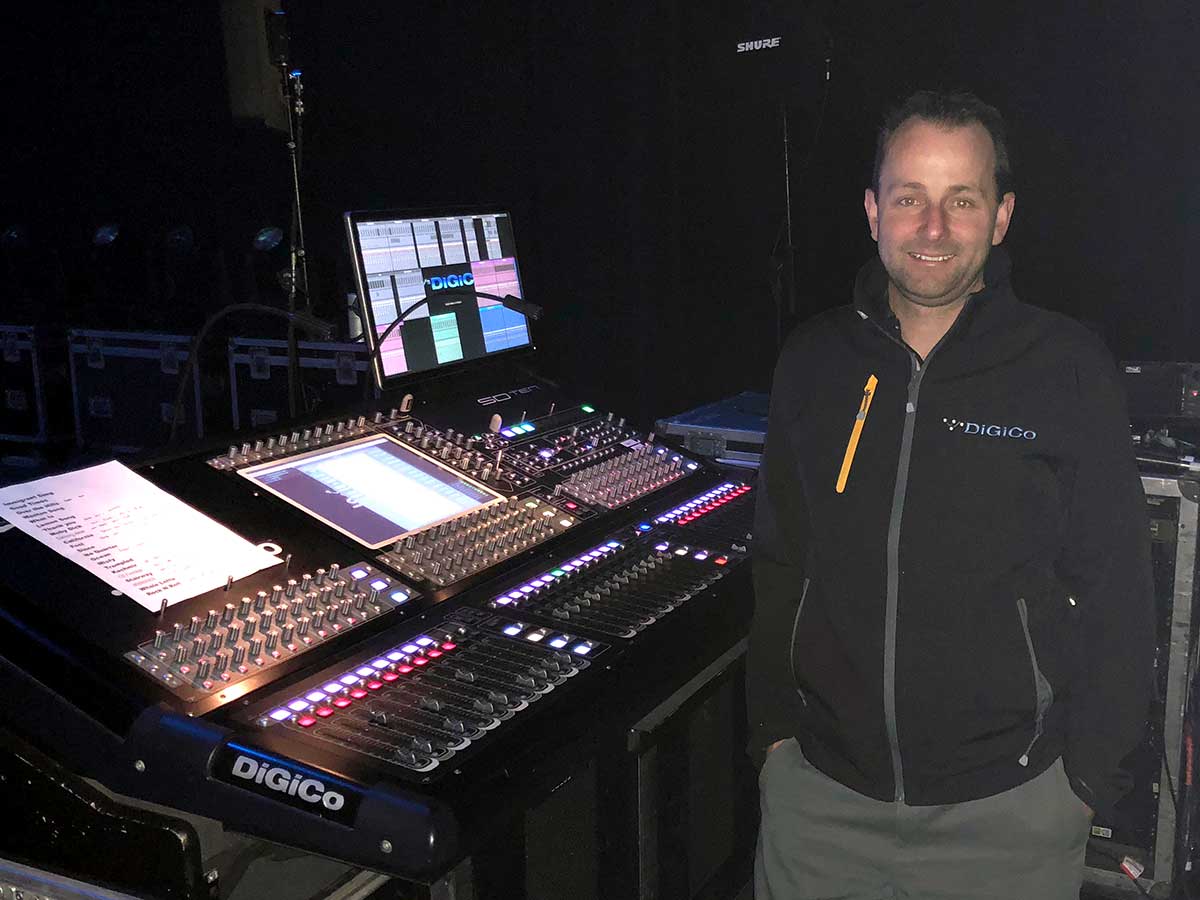
    FOH Pete uses a DiGiCo SD10 console, a surface he says he knows like the back of his hand. His one piece of outboard gear was a Lexicon PCM41 for use on just a few songs. “I’m a minimalist, and I like a small footprint.

    To cut down ambience and spill from all the live percussion into the vocal mics, Pete uses the Waves F6 Dynamic EQ plugin.
    I’m using the six bands of the F6 to really make the most of all the gain I have available on the vocals,” he explained. “I’m not a fan of permanent EQ on many sound sources, particularly vocals. I have the F6 plugin inserted via MultiRack on all the vocals, and I externally key one band of the F6 to act as a high-frequency downward expander, in addition to using several of the other bands as normal dynamic EQ.

    As the musicians rapidly change instruments throughout the show, the microphone systems have to be robust. The vocal mics are all DPA 4088s, DPA 4099 on most of the drums, Audix D6 on bass drums, Shure Beta 98s, Sennheiser e904s and Audio-Technica AE2300 for snares and high hats.

    The setup at monitor world is a DiGiCo SD5, and SD rack, an SD Mini Rack, and two Soundcraft real-time rack units, in addition to all the RF transmitters and receivers. In Australia, Dan Matthews ran monitors as the tour’s original monitor engineer, John Chadwick, took a dive off the stage and injured himself.

    Pete remarked that the other key piece of gear used was his ears and that he doesn’t look at sound if he can possibly avoid it! “Some folks spend their time focusing on what they’re seeing on metres and other visual indications, but I’m old school that way,” he laughed.

    David Byrne Crew
    Tony Szabo, Pete Keppler, Tim Jones

    To the audience, this show appears to be very simple but no one sees what is behind the success of the show – a very significant amount of technology. Pete commented that JPJ have been great and that his techs, Alex McCormack and Tim Jones, did an amazing job.


  • WWE Super Show-Down

    wwe 2018 photo 1

    WWE, in partnership with TEG Dainty, returned to Australia with WWE Super Show-Down, an historic event that took place at the Melbourne Cricket Ground (MCG) and featured the largest collection of WWE Superstars and Legends ever to appear in the country.

    JPJ Audio provided the audio for this prestigious event including a Clair Global Cohesion 12 Line Array PA that was located in the centre of the MCG firing outwards. Also supplied were a flown monitor system inside the ring, all the RF requirements, consoles, patch equipment and of course, an excellent crew.

    The design was based on twelve boxes of CO-12 per hang with two hangs at each corner of the stage,” said Alex McCormack, JPJ’s Crew Chief. “However, despite what appears to be a small amount of boxes, the coverage was great all the way to the very back of the grandstands.

    wwe 2018 photo 2

    For the FOH mix there was a DiGiCo SD10 along with a fully redundant SD9. Monitors also used an SD10, added in case there was a live band thrown in at the last minute. Our experience with WWE is you need to be prepared for last minute additions based on the direction of the live event, this set up allowed us to deal with any such situation.

    The entrance stage at southern end of the ground featured a ramp down to the ring for the wrestler and host entries. The stage and ramp housed monitors and wedges but no control gear as they were covered by the monitor system.

    A full, cutting edge Shure Axient RF system was positioned at front of house with wireless workbench monitored by the FOH engineer and JPJ RF tech monitoring the spectrum. Despite the MCG having significant challenges with multiple TV channels clashing in the middle of the stadium, it ran very smoothly.
    The channel count was kept relatively low compared to what we were prepared for,” added Alex.

    WWE’s Lance Vardis did FOH and Clair Global’s Daniel Laveglia executed all of the prep work in consultation with JPJ’s Mats Frankl to ensure a successful event. This was no mean feat as the event was nothing like a typical WWE arena setup.

    Despite being held in Melbourne, there was not a single drop of rain during the six days our gear and crew were exposed to the elements!


  • Cher – Here We Go Again Tour

    Cher 2018

    The Here We Go Again Tour is the seventh solo concert tour by Cher in support of her twenty-sixth studio album Dancing Queen. The Australasian tour was a brand new production and as Cher shares the same management as Pink, some of Pink’s crew stayed on for the tour.

    JPJ Audio supplied an audio package and crew for the tour including an L-Acoustics K1/K2 PA system.

    I do like the L-Acoustics K1/K2 PA and although there are many good PAs on the market, I believe it to be the best sounding,” commented Cher’s audio engineer Tony Blanc. “The setup on this tour is pretty generic from the board out, it’s exactly as L-Acoustics recommends; the cable lengths, the hangs and the combination of the K1s, K2s and the KS28 subs. It’s configured off LA Manager and I’m fortunate to have Johnny Keirle with me and he is probably the best system tech in the business. He knows how to tweak the PA. He sets the PA everyday depending on the parameters of the room, the sizes, the elevation of the seats and the throw. I am in the driving seat and it feels like a Ferrari.

    Tony reports that the K1/K2 combination allows him to precisely ensure that all the seats have the same energy. Quantities of PA varied a little at each venue depending upon the ceiling height and how far round the seats had been sold. However, the specified system had 24 x K1, 36 x K2, 24 x KS28 and 9 x Kara.

    For FOH control Tony ran a DiGiCo SD7 console which he said is worth twice as much as his original house!

    It’s an amazing console,” he said. “Before I started with Cher, I had three or four years on budget tours and I got quite used to Waves as a source. I had it with this console but after a day, I turned it off as it just changed the way the console felt. The only auxiliary gear I have are six channels of Summit DCL200 compressors to warm things up and a Lake EQ inserted on Cher’s vocal subgroup. I also have a couple of Bricasti M7 reverbs.

    With a fifty year career, a Cher show covers many different genres of music including ballads, sixties pop, rock and disco, all of which keeps Tony on his toes.

    Monitors were run by Martin Pare also on a DiGiCo SD7 console with a TC Electronic M6000 MKII system. All of the band, and Cher herself, wore Shure PSM 1000 IEM systems with L-Acoustic ARC sidefills to give the dancers some audio to dance to.

    Cher’s customized, handheld microphones were Sennheiser SKM5200s. Guitars and keyboards are all direct outputs. The kick drum had a syn901, plus the Audix D5, the snare an e905, toms e904 and cymbals ATM450s.

    Tony made special mention of the two JPJ crew out on tour with him – Kellie McKee and Joel ‘Cellphone’ Pearson – praising their work effort.
    Cher 2018

    Stage is covered by Hilario Gonzalez, a Solotech audio crew chief tech who works on the Vegas show, and his main concern being prepping Cher.
    Cher 2018


  • ‘Coachella for accountants’ – Xerocon Brisbane 2018

    Xero  Con 1

    Xerocon was launched by leading accounting software brand Xero back in 2010 and today is the largest accounting technology conference in Australasia.

    It brings together more than 3000 accountants, bookkeepers and financial professionals from Australia, New Zealand and Asia.

    “Hailed ‘the Coachella for accountants’, Xerocon has achieved an almost cult-like following amongst the best in the business, so it was essential that Xerocon Brisbane 2018 delivered unrivalled heights of engagement and emotion,” said Laura Roberts, Managing Director of brand communications company INVNT and Xerocon’s event agency.

    Held at the Brisbane Convention & Exhibition Centre, JPJ Audio were contracted by INVNT and technical directed by Matthew Russell, to supply an audio solution to match the event’s high production values. A solution was required that could cater to the opening act of a high energy DJ to clear crisp intelligible audio to enhance the meaningful and passionate stories told by keynote speakers.

    The show was held in the round plenary style and as with most corporate productions, it was imperative that the video screens could be viewed with no obstruction. Fortunately JPJ Audio are very experienced in working PA placement into a video setup and as usual, delivered a successful outcome.

    With four massive video screens forming a cube above the round stage, a neat and tidy PA system was required so as not to interfere with the visuals. Eight hangs of nine L-Acoustics dV-Dosc were deployed all in a left/right configuration at each corner.

    It was planned to add L-Acoustics dV-SUBs to the PA hangs but weight restrictions on the roof were severe and so the subs were placed under the stage.

    Xero Con 2We had twelve SB218 subs in a circle to get a nice wide rumble and big sub feel for when the content had low end in it, just to help get the crowd pumping,” added Matt Morrison of JPJ Audio. “We also had twelve L-Acoustics 108P around the stage for front fill. Originally the client wanted them underneath the stage with the subs so they were hidden but a solid fascia was added to the set which meant you couldn’t hear them! We redesigned the system by placing them around the video monitors onstage to cover the first few rows. It all looked neat and tidy in the end and of course, sounded great.

    Control for the plenary system was on a compact yet powerful Digico SD11 operated by Gary Flemming.
    During the day the venue was broken into six theatres, one used the plenary control whilst the others all had their own small control system, three with Soundcraft Si compacts and two with Yamaha O1V96. These all fed The PA People who provided silent-disco PA systems.

    The PA People handed FM receivers out to everyone and set up an FM control which we plugged in to and that’s how all of the breakouts could go at the same time,” explained Matt. “Everyone in the crowd had a receiver into which they could punch a pre-set frequency to listen to whichever breakout they wanted. It was a great little system.

    With audio, lighting and video all competing for weight allocations, this was no simple project but JPJ’s experience shone through.

    JPJ Crew:

    Tim Seconi, Will King, Matt Morrison, Daniel Charlton, Matt Debien.


  • The Merivales

    The Merivales

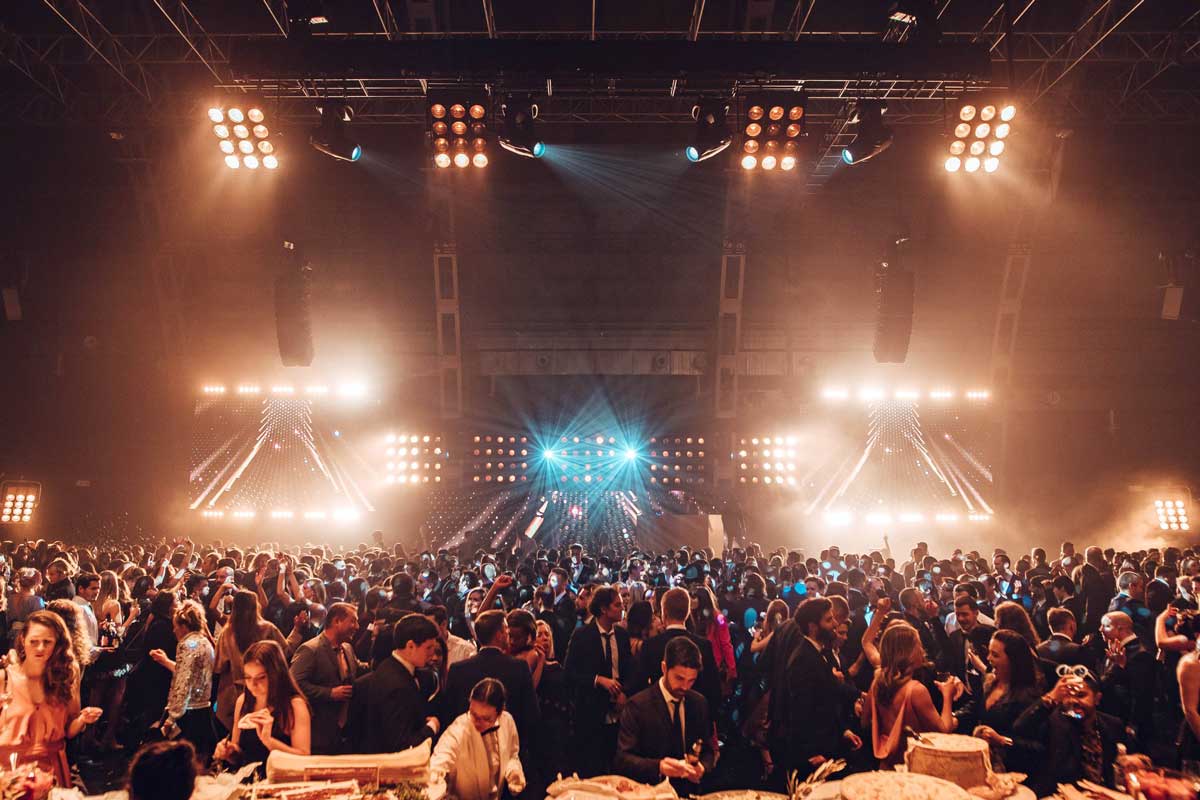
    The Merivales (the Merivale Company’s Internal Awards) brings together some of the leading hospitality personalities in Australia to highlight success within the Merivale business. It’s an evening charged with the electricity of celebration, decadence and communal spirit.

    The 2018 Merivales was held this year at Fox Studio’s Stage 7 with JPJ Audio working closely with Bailey Holloway, Group Production Manager for Merivale, to ensure a successful event. The night comprised of speeches, DJs and a traditional Japanese drumming troupe.

    Fortunately Stage 7 is a very well treated room – well it is a sound stage after all – which benefited FOH engineer Will Krienke who remarked that the production was fairly simple in terms of time alignment.

    It wasn’t like a standard show where you’re mainly taking care of a band,” commented Will. “It was the same amount of priorities but applied to making sure the client was satisfied with the flow. It was seamless from beginning to end with no changeover or down time.

    With the back of stage exposed, including dimmer racks, and high bay lights used, the theme was set for an ‘industrial’ feel to the night.

    We used an L-Acoustics KARA system which is a smaller box but it worked out perfectly for this job as there was no band and we were throwing on the short end of the building,” said Will. “We had nine KARAs per side over four SB28 subwoofers and ARC outfills. We had also had 108Ps around the stage for front infills. As simple and standard as it was, the main obstacle was making it look good as the client was very concerned with the aesthetics of the room.

    At FOH Will ran a DiGiCo SD11, the perfect size console for this job, using solely onboard gear as he only had ten inputs.
    Shure radio microphones were used for the speeches with DPA d:vote 4099 added specifically for the drummers.

    They’re just more musical as far as wireless is concerned,” said Will. “They’re full range and great for drums and all sorts of percussion.

    The entrance to the event featured a small L-Acoustics 112P PA which was driven wirelessly with a Sennheiser in ear unit.

    JPJ Crew:

    Joel Larsson, Chris Robinson

  • The Presets

    The Presets 1

    Legendary Australian electronic duo The Presets have been back on the road promoting their Hi Viz album and JPJ Audio were with them all the way.

    Having used an Avid Profile console for many years, FOH engineer Craig Gordon was keen to take an Avid Venue S6L console, with Waves card, on this tour and now he doesn’t want anything else!

    I love the Venue S6L and will find it hard to go back to a Profile,” he admitted. “I did a show last night with The Presets using a Profile and it was definitely not as good! The S6L certainly sounds better and there are way more options to customise the surface to how you want to use it. You can move all the groups and channels to wherever you want and set layouts, which you couldn’t do on the old console. You have outputs and auxes all on the same page, wherever you want to put them – and I really missed that last night on the Profile.

    Craig says that mixing for The Presets is fairly straightforward, as they have good backing tracks and decent sound coming to him.

    The Presets 2
    We had to do a few little things with Kim’s toms because he has really dead sounding disco toms but we figured it out with a few plugins,” added Craig.

    Julian had his own effects for his vocal onstage to which Craig sometimes added some distortion or reverb just to beef up what he is already being sent. The majority of the effects were Midi timecoded so through the songs they change to different presets which is all done onstage.

    I mainly use the dynamic stuff in the rack and a few plugins onboard like a C6 but not too many,” said Craig. The outboard rack is pretty good with Alan Smart Research C2 stereo comps and Puigchild compressors. I still like to have the knobs and visual more than the plugins.”

    The tour utilised inhouse PA systems but carried extra d&b B22 subs to reinforce the low end which worked well and was particularly useful in the smaller venues. The exception was Melbourne’s Forum Theatre where JPJ provided an L-Acoustics V-DOSC system.

    Microphones were a Shure package as the band have been Shure endorsees for a long time. Vocals were Shure BETA 58s on UR radios, a standard Shure drum package of BETA 52s, KSM overheads and KSM 32s.

    Cam Elias ran monitors on an Avid Profile using Shure PSM1000 IEMs.

    JPJ Crew: Stacey Handley, Tim Lonergan

  • Led Zeppelin Evening as Bonham

    Jason Bonham 1

    Jason Bonham’s Led Zeppelin Evening As Bonham garnered rave reviews as it toured through the country in May. The concert celebrates the life and music of his father, the legendary Led Zeppelin drummer John Bonham, and it was clear that this was a gig FOH engineer Tim Millikan was enjoying immensely.

    I’m like a dog with ten dicks at the moment!” he enthused. “It’s astounding, if you close your eyes you’d swear it was Led Zeppelin. The set goes for up to 2&¾ hours and covers a broad range of Led Zeppelin material. Having grown up listening to Led Zeppelin, I felt that I had been mixing it forever. There were times during the first show when I had to look up to check it wasn’t Robert Plant singing.

    Tim Millikan

    JPJ Audio provided a FOH control package with inhouse PA systems used around the country. Out front, Tim decided upon an Avid Profile simply due to its ease of use and availability around the country and in New Zealand.

    I wasn’t sure what to expect prior to the tour so I thought I’d best make it easy on myself,” he explained. “I also have a couple of Avalon VT-737 out front for vocals and that’s about it. It’s a pretty stock standard package without much extra in the outboard world.

    However Tim remarked that there was quite a lot going on with onboard effects including pitch shifters going into a SansAmp for some crunch and distortion on the vocal.

    I run the pitch shift return pretty hard into that at times for the vocal effects such as in No Quarter and Since I’ve Been Loving You,” added Tim. “I have a super heavy duty flanger that I run the drum kit through for the big drum fill sections in Kashmir. There’s a long delay with a single repeat at about 600 milliseconds for all the extended vocal Robert Plant stuff and the rest is all short verbs just to sweeten things up. I don’t try to effect it too much preferring to let the band do its own thing. The keyboard sounds are fantastic and he’s clearly done a lot of work to replicate the Led Zeppelin sound. So a lot of it comes to me already sitting pretty well, the balances between patches is great and there are no issues there.

    Tim added that he is not overly compressing anything, just some multiband compression to tickle groups so it doesn’t get too out of control when they’re really going for it.

    He spent more time concentrating on the overhead sound of the kit in general so when Jason hits the cymbals, they’re big and rich.

    I aim for a very natural sound using very light gating on the drums. It’s so super dynamic, you can’t squash it down too much and hold it in a position. I’ve got a C6 Multiband Compressor running over my master buss and I’m using that into an L3 Multimaximizer for a little bit of mastering on the output just to keep it in check.

    As it is such a long show, Tim explained that he tries to keep the sound level at around 95dB despite having had some people say it should be louder.

    For 2 ¾ hours that would be uncomfortable,” he said. “I can tighten up or loosen up the low end of my master stage to give a little more power when it needs it and pull it back when I want to keep it under control.

    Monitors were taken care of by Conor Dunne on a DiGiCo SD10 running Sennhieser IEMs and Shure radio mics. Jason also has a robust Stereo drum fill in the form of an L-Acoustics SB118 sub with an ARC II on top.

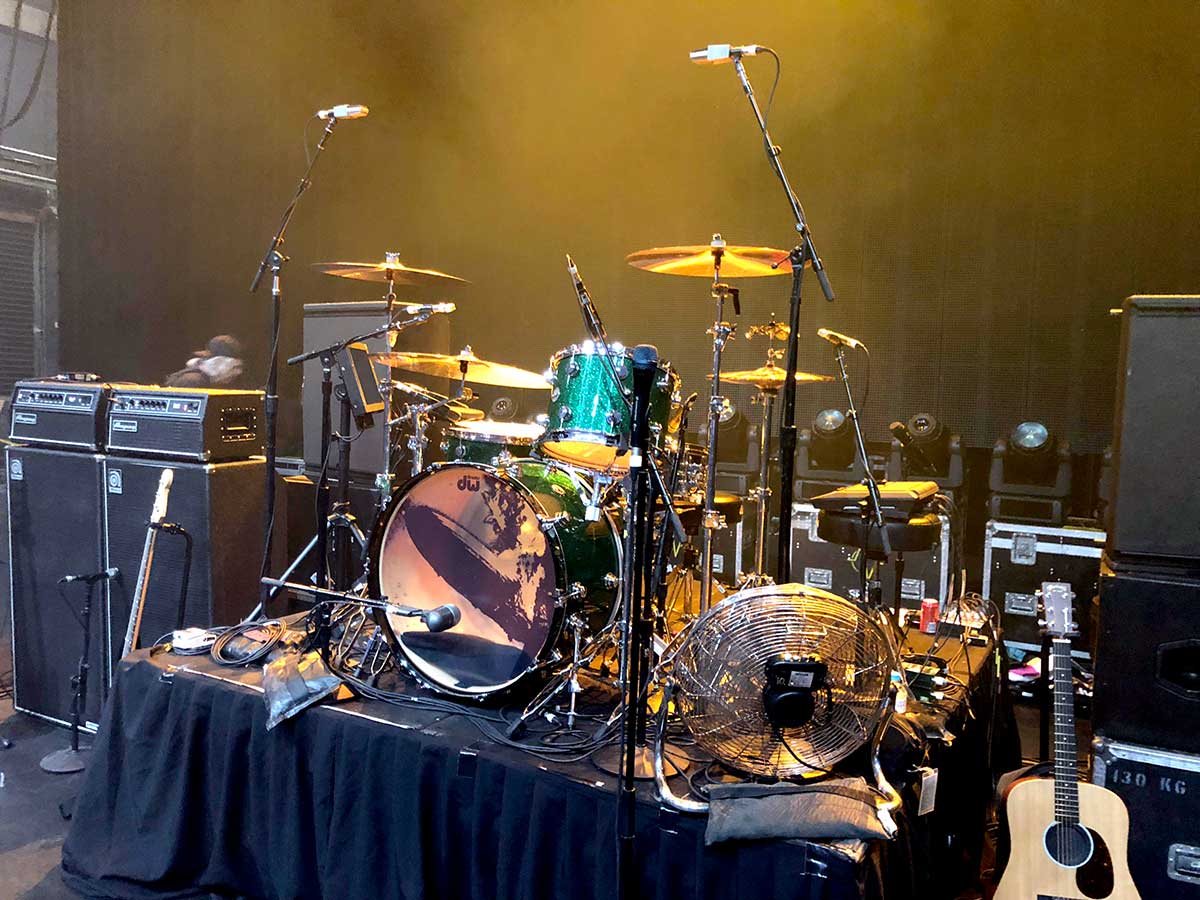
    It’s pretty loud onstage which in smaller venues makes it pretty tough,” said Tim. “The guitar player has a pair of 100 watt Marshalls running pretty hot plus there are two Ampeg SVT 8 X 10 rigs for the bass. The keyboard rig had a couple of Nord Stage 2s then there are a couple of acoustic guitars and a mandolin.
    Jason has a Crown CM311 head-worn condenser microphone as he sings in a couple of songs but mainly talks in between songs, although sometimes he also uses a Shure KSM9 radio mic.

    For the drums there is a Shure Beta 52 on the kick drum (no hole in the kick drum so it’s placed directly in front), Shure 57s on top and bottom of snare, Shure 181 on hats and ride, Sennheiser 421s on toms and 414s on overheads. Guitars are Sennheiser e906 and Audio Technica ATM450 whilst vocals are Sennheiser e945 and e935. DIs were a combination of Radial J48s and JDIs as well as Countrymans.

    Tim was clearly in his element with this tour adding that the band’s crew were great and that Jason himself is a lovely bloke, in fact it’s one of the most chilled and casual tours he’s done in a while. And Tim must have done something right as he has been asked to join the American run ….. work Visa pending.
    Rule number one of touring – don’t leave home without your passport!


  • The Killers produce a Killer Tour

    The Killers 1

    FOH Engineer Kenny Kaiser has been working with The Killers since the start of their Battle Born tour, where he started out as a system tech, then moved into the role of FOH mixer towards the end of that tour.

    Kenny comments that when mixing The Killers there are many, many elements to consider. As there are so many people, instruments, and inputs on the stage he aims to keep things very simple at FOH saying that he prefers to keep as little failure points as possible!

    Out front Kenny was running a Solid State Logic SSL500 console which he says sounds great.

    So right off the bat that is the best feature of this console,” he added. “After that it had to do with reliability. By far the biggest thing on this console that does not get much press is the All Pass filter. It’s a game changer to me. I am also a big fan of the delays and reverbs on the L500 followed by the bus comp and the subharmonic tool.

    The Killers 1Outboard effects were a couple of Bricasti M7 reverbs; one for lead singer Brandon Flowers and one for the snare. Kenny admits that’s a little over kill but it does sound good on the snare!

    For the Australian tour, the show featured an L-Acoustics K1/K2 PA with the mains and sides comprising of K1 with K2 underneath. The amount of K1 for each hang changes per show but it is four K2 for the under hangs. Between the main and side hang at a 45 degree angle are flown K1-SBs.

    The PA has been great with even coverage and no complaints so far, from myself or the crowd,” commented Kenny.

    Monitor engineer Marty Beath also ran a Solid State Logic SSL500 console with everyone but Brandon utilizing Shure PSM1000 IEMs and Axient AXT400. Brandon used a total of ten M2 wedges with two d&b J8s on top of a single d&b J-Sub for side fills.

    For microphones, Brandon favoured a Shure Beta SM-58A, all the mics on the drums are Telefunken M80s and M81s, the cymbals are Heil PR30, guitars are Heil PR30, and all the backing vocals are on Heil PR35.

    The service from JPJ Audio had been great and the crew is A-level,” remarked Kenny. “Marty and I came into this run with a little concern about packaging because there are a lot of elements to the show and being able to set everything up in time is a big deal. JPJ Audio were able to make all the carts and dollies we asked for, so every day we were able to have a little time for a coffee before the band showed up …… so my hat is off to JPJ!

    JPJ crew were Tim Seconi, Paul Kennedy, Joel Pearson and Kellie McKee.