Tag: Midas

  • Paul McCartney 2017

    Paul McCartney 2017

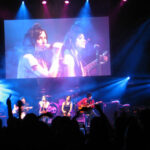
    Two-time Rock and Roll Hall of Fame inductee, 21-time Grammy Award winner and recipient of The Most Excellent Order of the British Empire Sir Paul McCartney brought his acclaimed long-running One On One Tour to Australia this December, his first Australian tour since 1993’s The New World Tour more than 24 years ago.

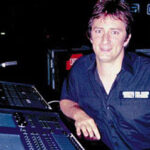
    The show featured nearly three hours’ worth of the greatest moments from the last 50 years of music, dozens of songs that have formed the soundtracks of our lives. FOH engineer Paul Boothroyd – known more commonly in the industry as Pab – has been with Sir Paul for a fair portion of this journey.

    I first started working for him in 1989,” said Pab. “As well as being on stage for three hours, he also does a one hour sound check every day. With line checks and system checks as well, I’m probably behind the console twiddling knobs for five hours so it’s quite an extensive day technically.

    That FOH console was an Avid Venue S6L which Pab has used ever since it was released and he describes it as one of the best consoles on the market. Pab’s S6L carries dialed-in snapshots for more than 100 songs.

    It’s very powerful and has massive capability,” remarked Pab. “My vocal chain for Paul is fairly straightforward; I’m using a Sonnox Oxford EQ and Avid Pro compressor. For effects there are some general reverbs (short, medium and large), a little bit of delay ADT and that’s it. There’s no playback or inputs from anywhere else, it’s all live.

    Plug-ins that are used sparingly include Smack!, ReVibe II, ReVibe I on drums and Mod Delay III.

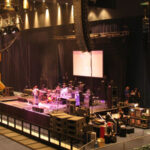
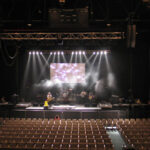
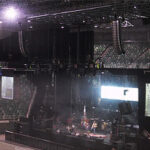
    JPJ Audio supplied the crew and gear for the tour including their Clair Brothers’ Cohesion Series for PA. At the Sydney show indoors at Qudos Bank Arena, Pab had sixteen CO12 L+R, fourteen CO12 LL+RR, twelve CO12 LLL+RRR, six CP218 Subs flown per side, three CP218 Subs per side ground stacked and twelve CO8 for front fill.

    It’s absolutely the PA of choice for me,” said Pab. “I find it very flexible, light, and simple to manage. It delivers great results and is very accurate.

    The stage is fairly loud with only Wixy (musical director/multi-instrumentalist Paul “Wix” Wickens) wearing IEMs. The rest of the band opts for Clair R4 sidefills with ML18 subs and SRM wedges. Monitor engineer John “Grubby” Callis uses an analog Midas Heritage H3000.

    It’s very old-school rock and roll,” says Pab. “It’s loud sidefills and wedges up there because he likes to rock out.

    Microphones were a mixed bag with Pabs never swayed by fashion or freebies preferring to apply the correct microphone to suit the job.

    I like Audix on the drums and Shure for the vocals,” he added. “Paul’s very happy with the SM58A because he’s used to it – there may be a better microphone to suit his vocals these days but he is very used to what he has had for the past thirty years. So why change?

    Having not toured Australia for a good few years, Pab says he was very pleased to be greeted with such a professional JPJ team, a very happy team who just dealt with anything that was asked.

    Thanks JPJ for the fun and hard work, greatly appreciated,” he added.

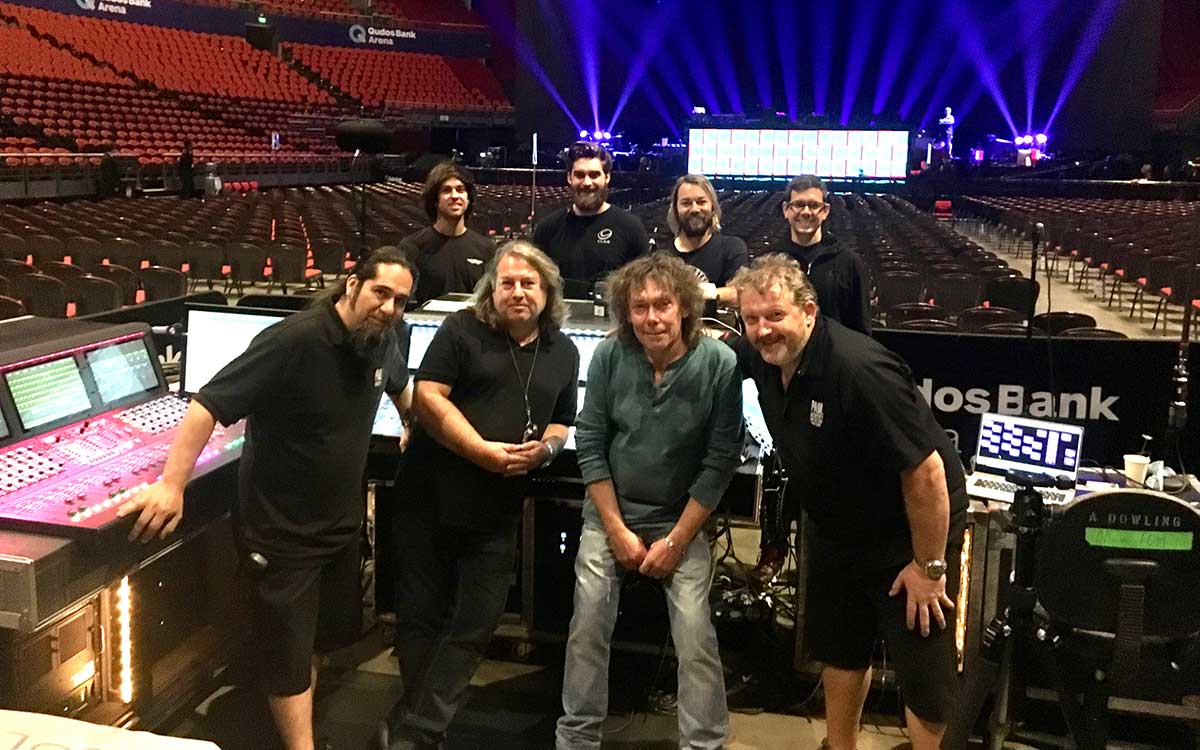
    One On One Tour Crew

    Paul McCartney crew
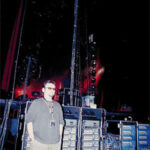
    Back row: Joel Larson, Alex McCormack, Tim Seconi, and Andrew Dowling SE from Clair Global
    Front row: Tech Sean Baca, FOH engineer Paul ‘Pab’ Boothroyd, monitor engineer John ‘Grubby’ Callis, and monitors system engineer Paul Swan.


  • Big Day Out 2014

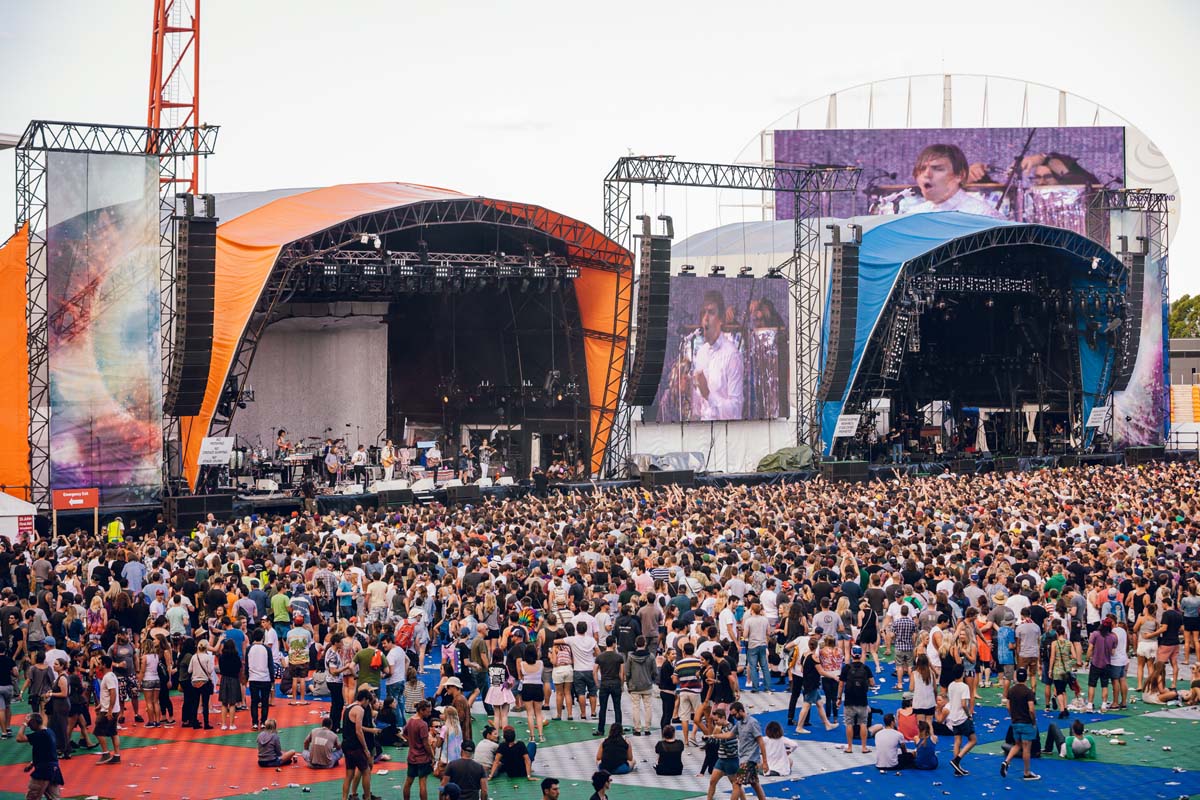
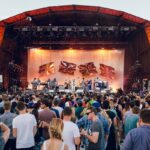
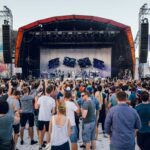
    Orange & Blue Stages

    Australia’s foremost music festival, The Big Day Out, debuted on the 1992 Australia Day public holiday in Sydney and expanded to Adelaide, Melbourne and Perth by the following year. The Gold Coast and Auckland were added to the schedule in 1994. As of 2003, it has featured seven or eight stages (depending on the venue) accommodating popular contemporary rock music, electronic music, mainstream international acts and local acts.

    JPJ Audio (previously trading as Jands Production Services and Johnston Audio) has provided the sound systems for every Big Day Out show since 1992 and 2014 was no exception. The festival usually takes place in late January and this year was held in four Australian cities: Gold Coast (Jan 19), Melbourne (Jan 24), Sydney (Jan 26), Adelaide (Jan 31) and Perth (Feb 2).

    Orange / Blue Stages – FOH Speaker System
    • 68 L-Acoustics V-DOSC Enclosures
    • 48 L-Acoustics SB218 Sublow Enclosures
    • 18 Amplifier Rack, L-Acoustics (4x5002VZ)
    • 4 Amplifier Rack, L-Acoustics (2x5002VZ)
    • FOH Speaker System Delays
    • 18 L-Acoustics Kudo Enclosures
    • 2 Amplifier Rack L-Acoustics LA-RAK (3xLA8)
    • FOH Drive
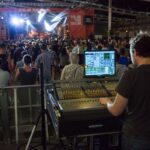
    • 1 Midas PRO1 Digital Mixing Console
    • 1 L-Acoustics V-DOSC Drive Rack (4xDolby)
    • Blue Stage FOH Control
    • 1 Digidesign Profile Control Surface
    • 1 Digidesign Venue FOH Local Rack
    • 5 Digidesign DSP Mix Engine
    • 1 Midas PRO2C Digital Mixing Console
    • Monitor Speaker System
    • 18 d&b M2 Monitor Enclosure
    • 2 d&b Q-SUB Sublow Enclosure
    • 6 L-Acoustics ARCS Enclosure
    • 4 L-Acoustics dV-SUB Sublow Enclosure
    • 3 Amplifier Rack, 4mix d&b D-12
    • 12 d&b D-12 2ch Amplifier
    • 2 Amplifier Rack, ARCS (2xLA48+366)
    • Monitor Control
    • 1 Yamaha PM5D-RH Digital Console
    • Orange Stage Control
    • FOH Control
    • 1 Digidesign Venue Digital Console System
    • 1 Digidesign Profile Control Surface
    • 1 Digidesign Venue FOH Local Rack
    • 1 Digidesign Venue Stage Rack
    • Monitor Speaker System
    • 16 Clair Bros 12AM Monitor Speaker Enclosure
    • 3 Amplifier Rack, 4mix 12AM (Crown 3600)
    • 2 Clair Bros ML18 Sublow Enclosure
    • 2 Amplifier Rack, ML18 (Crown MA9000i)
    • 6 L-Acoustics ARCS Enclosure
    • 4 L-Acoustics dV-SUB Sublow Enclosure
    • 2 Amplifier Rack, ARCS (2xLA48+366)
    • Monitor Control
    • 1 Yamaha PM5D-RH Digital Console
    • 1 Yamaha PM5D Power Supply Rack
    • Red Stage
    • FOH Speaker System
    • 18 JBL VERTEC 4889
    • 16 JBL VERTEC 4880
    • FOH Control
    • 1 Digidesign Venue Digital Console System
    • 1 Digidesign Profile Control Surface
    • 1 Digidesign Venue FOH Local Rack
    • 1 Digidesign Venue Stage Rack (48in, 32out)
    • Monitor Control
    • 1 Digidesign Venue Digital Console System
    • 1 Digidesign Profile Control Surface
    • 1 Digidesign Venue FOH Local Rack
    • 1 Digidesign Venue Stage Rack (48in, 32out)
    • Monitor Speaker System
    • 14 Clair Bros 12AM Monitor Speaker Enclosure
    • 1 L-Acoustics dV-SUB Sublow Enclosure
    • 1 Amplifier Sleeve, dV-SUB (1xLA8)
    • 2 Amplifier Rack, 4mix 12AM (Crest)
    • Sidefill
    • 6 L-Acoustics dV-DOSC Enclosure
    • 2 L-Acoustics dV-SUB Sublow Enclosure
    • 1 Amplifier Rack, L-Acoustics 115XT HI-Q (4 mix LA8)
    • Boiler Room FOH Speaker System
    • 18 L-Acoustics V-DOSC Enclosure
    • 6 L-Acoustics dV-DOSC Enclosure
    • 8 L-Acoustics ARCS Enclosure
    • 16 L-Acoustics SB218 Sublow Enclosure
    • 6 Amplifier Rack, L-Acoustics (4x5002VZ)
    • 4 Amplifier Rack, L-Acoustics (2x5002VZ)
    • 1 L-Acoustics V-DOSC Drive Rack (4xDolby)
    • FOH Control
    • 1 Digidesign Venue Digital Console System
    • 1 Digidesign Profile Control Surface
    • 1 Yamaha O1V96 Digital Console (16 Mono + 4 Stereo)
    • Monitor Speaker System
    • 14 Clair Bros 12AM Monitor Speaker Enclosure
    • 2 Amplifier Rack, 4mix 12AM (Crown 3600)
    • 4 Clair Bros R4 Mk III Speaker Enclosure
    • 1 Amplifier Rack, R4 (Crown MA9000i)
    • 6 Clair Bros ML18 Sublow Enclosure
    • 2 Amplifier Rack, ML18 (Crown MA9000i)
    • Monitor Control
    • 1 Yamaha PM5D-RH Digital Console
    • 1 Yamaha O1V96 Digital Console (16 Mono + 4 Stereo)
    • DJ Monitors
    • 9 L-Acoustics dV-DOSC Enclosure
    • 6 L-Acoustics dV-SUB Sublow Enclosure
    • 2 Amplifier Rack, L-Acoustics 115XT HI-Q (4 mix LA8)
    • 2 Amplifier Sleeve, dV-SUB (1xLA8)
    JPJ Crew
    • FOH System Engineers
    • John Kerns
    • Tim Millikan
    • Brendan Keane
    • Tim Seconi
    • Monitor System Engineers
    • Paul Kennedy
    • Tristan Johnson
    • Tristan Farrow
    • Josh Andre
    • Stage Technicians
    • Duncan Kaye
    • Dean Marquis
    • Matthew Morrison
    • Alex McCormack
    • Aaron Casley
    • Wayne Mulder
    • Jorgia Galbraith
    • Tim Jones


    Gallery – All photos ©Daniel Boud

  • Pearl Jam 2009

    Story & photos by Cat Strom. Originally published in Pro Audio Asia

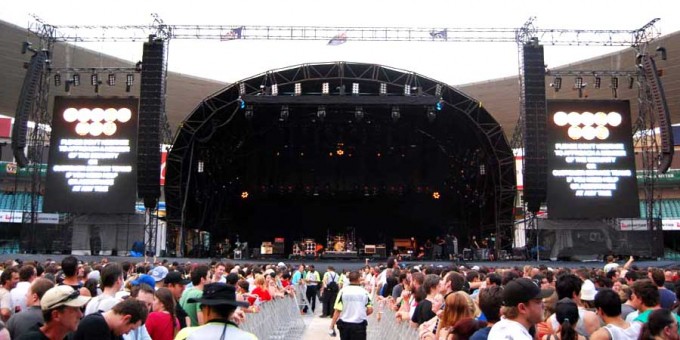
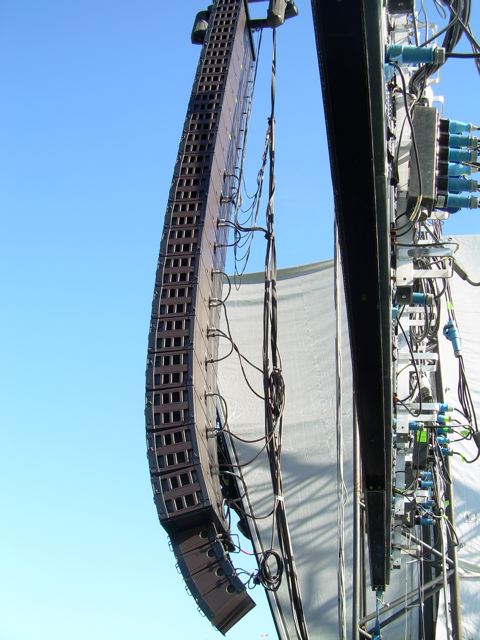
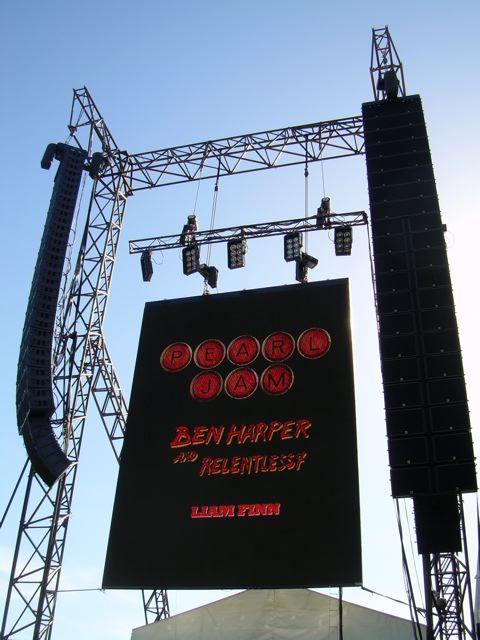
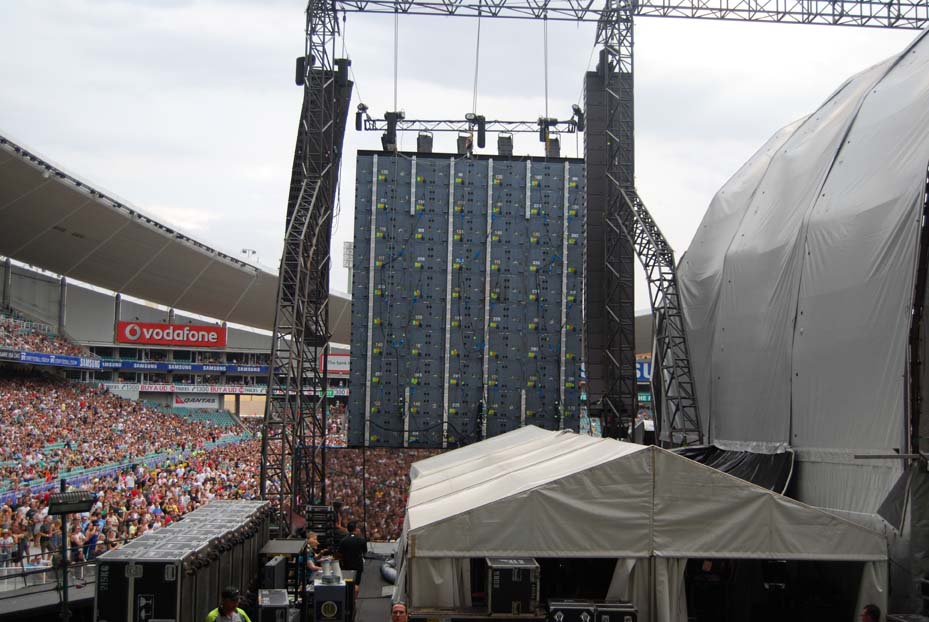
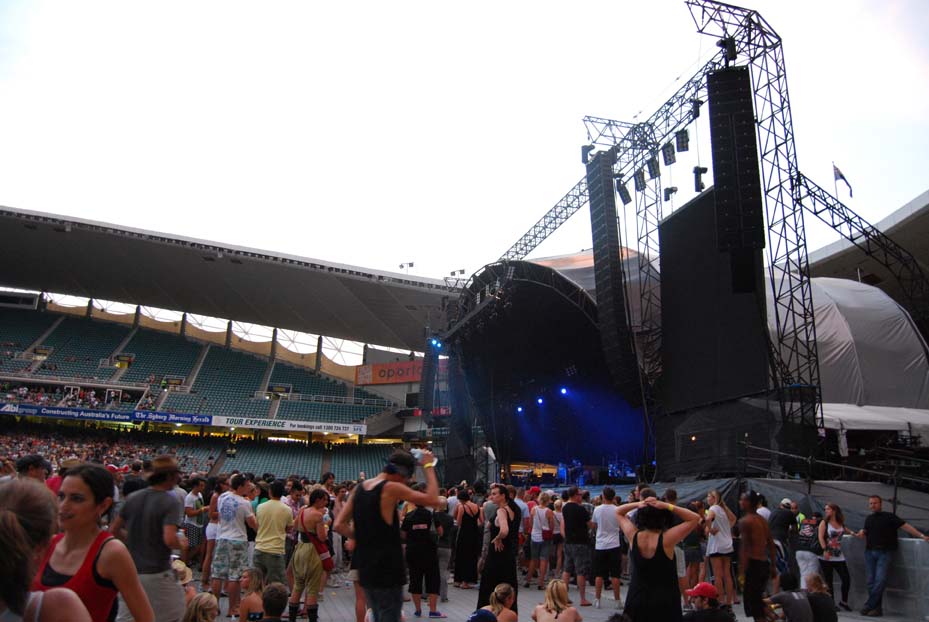
    Excessive temperatures and strict noise pollution controls faced Pearl Jam and their crew at their massive outdoor gig at Sydney’s Football Stadium in support of their latest release, Backspacer. This was also the tour that Australian rental-company and long-standing L-Acoustics Rental Network Agent, Jands Production Services (JPS) was using to debut its new K1/Kudo line array system.

    JPS – along with several of the world’s leading rental companies – are collaborating with the L- Acoustics R&D team in advanced field proofing of the new system that is specifically designed for stadiums. As a result the company has taken delivery of one of the limited number of K1 systems in the pilot programme. “The new K1 isn’t intended as a replacement for V-Dosc,” explains Jim Straw, JPS general manager. “The combination of K1 and Kudo is aimed at providing a scaled solution for large venues with Kudo providing a flexible horizontal and greater vertical dispersion, while the K1 offers fixed horizontal dispersion with a maximum of 5° inter-element angles for larger venues.

    Pearl Jam’s FOH engineer, Greg Nelson, first heard the K1 system at Coachella, admitting that he was ‘blown away’ with how much sub bass could be achieved out of the main flown system. “Ratsound, our sound provider in the US, had purchased the system and I got to preview it at last year”s Coachella festival. I was wildly impressed with the performance,” he says. “The box just sounded better than anything else I had ever heard – straight out flat, just turn it on and go.
    (more…)

  • Future Music Festival 2009

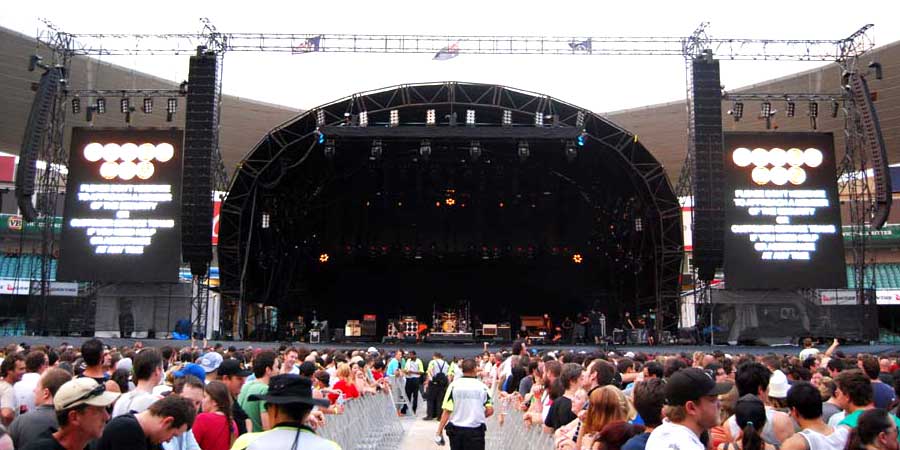
    JAS audio supplied the audio for Melbourne’s Future Music Festival and the move from the Myer Music Bowl over to the Flemington race track increased the audience to around 35,000.

    For the main stages in Melbourne and Sydney a Nexo Geo T system was used while L-Acoustics VDosc was used for the main stages in Brisbane and Adelaide.

    Dates

    February 28
    March 1, 7-9

    Melbourne Future Festival

    Main stage

    32 x Nexo Geo T
    16 x Nexo C-D 18 subs
    32 x Camco Vortex 6 amplifiers

    FOH

    1 x Midas XL4
    1 x Digidesign profile console

    Monitors

    1 x Midas H3000
    1 x Digidesign profile console
    16 x Wayloud Wedges
    2 x Nexo Alpha E side-fill systems

    God’s kitchen stage

    16 x L-Acoustics VDosc
    12 x Wayloud 218 subs

    Consoles

    2 x Yamaha PM5D

    Monitors

    16 x PS15 wedges

    Yellow stage

    16 x Nexo Alpha
    8 x Nexo Alpha S2

    Sydney Future Festival

    Main stage

    32 x Nexo Geo T
    16 x Nexo C-D 18 subs
    32 x Camco Vortex 6 amplifiers

    FOH

    1 x Midas XL4
    1 x Digidesign Profile console

    Monitors

    1 x Midas H3000
    1 x Digidesgin Profile console
    16 x Wayloud Wedges
    2 x Nexo Alpha E side-fill systems

    Godskitchen stage

    16 x L-Acoustics VDosc
    12 x Wayloud 218 subs

    Consoles

    2 x Yamaha PM5D

    Monitors

    16 x PS15 wedges

    Brisbane Future Festival

    Main Stage

    16 x L-Acoustics VDosc
    16 x Wayloud 218 subs
    6 x L-Acoustics ARCs

    FOH

    1 x Midas XL4
    1 x Digidesign Profile console

    Monitors

    1 x Midas H3000
    1 x Digidesign Profile console
    16 x Wayloud Wedges
    2 x Nexo Alpha E side-fill systems

    Adelaide Future Festival

    Main Stage

    16 x L-Acoustics VDosc
    16 x Wayloud 218 subs
    6 x L-Acoustics ARCs

    FOH

    1 x Midas XL4
    1 x Digidesign Profile console

    Monitors

    1 x Midas H3000
    1 x Digidesign Profile console
    16 x Wayloud Wedges
    2 x Nexo Alpha E side-fill systems

    NERD Touring package

    2 x Digidesgin Profile console
    4 x Sennheiser G2 in-ears systems
    4 x Shure U4D Radio mic systems

  • Veronica’s tour 2006

    Dates

    April 13, 15-16, 18-19, 21-24 2006

    System

    24 x Nexo Geo T 2405 line array
    6 x Nexo Geo T 2815 line array
    18 x Nexo Geo S line array
    16 x Nexo C-D sub
    Camco Vortex 6 Amplifiers
    Nexo NX241 / Lake contour controllers

    Consoles

    Midas XL4 FOH
    Midas H3000

    Monitors

    Wayloud monitor system

    JAS crew

    Bruce Johnston – FOH engineer / Production manager
    David Quigley – System technician
    Saul Skoutarides – Monitor operator
    Craig Gordon – monitor rigger

  • Powderfinger 2003/2004

    Powderfinger returned home to tour Australia after a very successful tour of Europe and UK. They brought the biggest version of their show to date. The arena sized show might be a major step up for the band, but the show has been translated to the big stage quite successfully by the team behind the production.

    Dates

    November 21, 23, 25-27, 29-30 2003
    December 5-7, 10, 12-15 2003
    System

    24 x Nexo Geo T 4805 Array
    6 x Nexo Geo T 2815 Array
    12 x Nexo Cd-18 Ultra Subs
    20 x Camco Vorte x 6 Amps
    4 x Nexo Nx241 Processors

    Side Hang

    8 x Nexo M3 Mid-High
    8 x Nexo B1 Bass Cabinets
    8 x Camco Vorte x 6 Amps
    2 x Nexo Nx241 Processors

    Infill

    4 x Nexo Alpha E-M
    1 x Camco Vorte x 6 Amp
    1 x Nexo Nx241 Processor

    FOH

    Midas Heritage H3000
    52 Channel Console
    1 x Al Smart C1 Compressor
    1 x Klark Teknik Dn 360 Eq
    1 x Lexicon Pcm 91
    2 x Lexicon Pcm 80
    1 x Tc M 5000
    1 x Tc 2290
    2 x Tc D-Two
    2 x Eventide H3000 SE
    2 x Empirical Labs Harmonisers

    Distressors

    7 x DBX 160 Compressors
    1 x Al Smart C1 Compressor
    8 Ch Drawmer 201 Gates
    4 Ch Db x 903 Compressors
    2 x Avalon Vt 737 Sp Mic

    Monitors

    1 x Midas Xl250 52 Channel Console
    8 x Klark Teknik Dn 360 Eq
    1 x Tc M2000
    8 Ch BSS Dpr 402

    Compressors

    8 Ch Drawmer 201 Gates
    16 x Nexo PS 15 Wedges
    8 x Nexo M3 Mid-High

    Side Fill

    8 x Nexo B1 Bass (Side Fill)
    12 x Camco Vorte x 6 Amps
    6 x Nexo Td Mkii Processors
    2 x Nexo Nx241 Processors

    Multicore System

    Optocore L x 4 Network

    Powderfinger Crew List

    Production Manager: Ifan Thomas
    Production Assistant: Oana Gilbert
    FOH: Mark McElligott
    Monitors: Steve Brown
    LD: Jason Boyd
    Stage Manager/ Matt “Matrix”
    Backline: McNamara
    Drums: Duane Billings
    Guitars: Chris “Toph” Hough

    Johnston Audio Crew

    FOH Rigger: Drew Menard
    System rigger: Paul Gould
    Monitor Rigger: Mark Crawley

    About the Audio – CX Magazine Article (January 2004)

    Mark McElligott is not a fan of Line Array systems, so it must have taken some convincing to get him to use the new Tangent Array system from Nexo. His close relationship with Johnston Audio and previous reliance on the Nexo Alpha system probably had a great deal to do with the decision. From Mark’s point of view, the Alphas were perfect for this band.

    “They still have that rock pedigree. The guitars sound like guitars. Not like Line Arrays – off axis they sound like shit.” The “clean, pristine” sound with little bottom end is not what Mark needed, so he was initially skeptical about the Nexo GeoT Tangent Array. However, after hearing the system in Brisbane during rehearsals for the tour, he decided to take a punt. The result has been very impressive sound for this tour. He said it took him a couple of shows to get used to the clarity and spread of the sound. “You hear the PA as one unit, they don’t sound like they are split up.” This is despite the fact that the subs are sitting in front of the stage and the main PA is set so high. The Nexo system is also capable of flying the Subs with the main PA, something that Mark would have liked to have done so that the front rows of punters were not flattened by the sound. However the hardware needed was not available by the time the show was underway, and standing in the front row in front of the PA subs wasn’t all that bad – in fact the audio quality there was exceptionally good!

    Coming from a studio background, Mark likes heavy use of compression in his live mix. The drum kit runs a special system of hard compression that is run back in the console and mixed with the live output. It probably runs about 50/50 compressed audio to live audio, which Mark describes as giving the kit some real punch. There is also lighter compression run over the Guitars and the whole mix output.

    The mics run into Avalon SPS727 valve based mic preamps – giving the vocals the warmth that Mark likes to hear in the vocal mix. Running with a slew of other effects – gates, reverbs, harmonizers, distressors (see list), this is a reasonably complex rig that Mark runs from the Midas Heritage H3000 console.

    Interestingly, Mark also uses a baby Allan and Heath 16ch console – one that would be more at home in a pub – for the small ‘acoustic style’ section. The idea is to give this part of the gig a different sound – which it certainly does.

    Another interesting part of this gig is that the FOH is connected to the stage via fibre optic cable rather than a traditional multicore. The Optocore LX 4 Network System allows for 48 channels of audio to be sent from the stage and 16 returned to the stage, all without signal loss and for a seriously long distance if required. The stage end of the system incorporates a remote controllable head end with built in mic preamps, remote switchable phantom power and even some data transfer.
    There are two RS485 returns from the FOH position which can be used for DMX or AES/EBU outputs, as well as a video send from the stage. A laptop at FOH controls the system, allowing the user to control master level for system balancing as required.

    How Mark McElligot got started

    Like many FOH engineers, Mark McElligott was a musician first until he saw the light and the employment prospects.

    A native of Townsville, Mark managed to get himself into Brisbane after lying about his abilities as an engineer to a covers band that needed an urgent replacement.

    Apparently there was enough native talent that he pulled off the gig without the band noticing – and thus started a career in studio and live engineering.

    Mark comes from the days when Brisbane had a vibrant live scene, and the bands used to occupy what is affectionately remembered as “The Target Building” – a disused Target store in Fortitude Valley that was taken over for a number of years in the eighties by Brisbane’s up and coming bands. This was a period of excitement for Mark, as he worked on numerous projects and bands in his studio. This was the environment that fostered Powderfinger themselves.

  • Silverchair “Across the Night” 2003

    Article courtesy of CX Magazine (May/June 2003 issue)
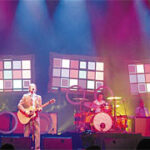
    Silverchair approached Rolling Stones levels of interest and enthusiasm on their Australian Tour across autumn. The five week run was designed for theatre and stadium, and featured an Australian pragmatism that a forty year old band like the Strolling Bones could never achieve.

    The parallels – guitar rock band; theatre AND stadium shows; fans who are welded on. The differences? About 150 people less on tour with the Chair. No physiotherapist, no personal chefs, no valets.

    Production values were similar, and in proportion too. Where the Stones toured the largest LED video wall currently in use on the planet, the Chair toured the new Barco LED wall from Technical Direction Co – Australia’s largest and best new wall. The Rolling Stones had a new line array PA – the Chair had a modern NEXO Alpha PA system.

    Patrick Woodroffe’s lighting design for the Stones had everything that moved, all controlled from a Hog II. Hugh Taranto’s design for Silverchair had more than enough in the way of fixtures – controlled from a Whole Hog III.

    What I’m getting at, is that Production Values need to fit the scale of the show, and the Rolling Stones 14 truck tour is not that far removed from Silverchair’s two truck loads. The people who matter – the audience – were well satisfied in both cases.

    I caught the tour at the Pallais Theatre and then two days later at the Vodafone Arena. The light and vision production was essentially the same in both venues, with less speaker boxes used for the 2000 Pallais than for the 6000 seat Arena. “It scales up nicely”, said the polite Hugh Taranto, veteran of many Silverchair tours. His lighting design was clever, because there was nothing flown in the grid that needed focusing, so no one needed to climb up there. That made a huge time saver, since the house worklights didn’t need to go out, and the safety issues of not having climbing crew are obvious.

    “We can go up there (there is a ladder) and we have the rescue gear. But if we need to change something we usually lower the grid.” I have arrived at the Arena at 3pm, and Hugh is sitting arranging his cues. The load in was at 0800, so good time has been made. The stage set is loosely based on the Diaorma album cover, so rainbow colours and weird set pieces are used. Three LED video walls are flown at the rear quarter of the stage, hung intentionally crooked. Huge fake picture frames make them look kind of grunge-retro. Each wall is 5 panels wide and 3 tall, so they each measure about 4.5 x 2.5 metres.

    Hugh operates the Whole Hog III, a wingboard, and three Catalysts – with 3 Mac G4 and 2 laptops. His FOH setup is complex, and hubbed together via an Ethernet switch. It is impressive to watch him work all this, alone, while calling two followspots. For the first half of the show, the three Silverchair members are joined by two guest keyboard players who are set on stage left, above and behind the backline. Coloured panels are over each backline speaker. Six ‘zip rings’ which are a circle of ten MR 16 lamps, are hung around the backline, giving Hugh another element to go with six Zip strips – sitting vertically around the stage, and gelled in rainbow hues.

    The band take to the stage with pungent incense burning, plumes of smoke rising, and do a set of new material than builds to a break. Hugh has imagery generated from 3 Catalyst systems (with 3 Mac G4’s) feeding the three screens. The images combine moving black and white clips from band videos, and a smorgasbord of patterns generated on Catalyst. As the sole lighting operator, Hugh has control over outputting the images through the Hog III – making the show very harmonized.

    “For the first half, the screens are set to 1000 nits. Then I turn them up (to 2000) for the second half. I’m using them more like lights them. They come in and flash, in colours, and are a big bright light.” Bright they are! The band wanted a quieter set with a different look for the first half. Behind the three oversized picture framed LED walls is a red drape. Lights play out a lot of looks, and two followspots very subtly fill out.

    The second half is achieved after the crew reset the stage behind a curtain. The rear red drape is gone, revealing three pods of 24 Par 64’s, using 240v lamps so they can be chased in many combinations. Each is gelled.

    A directive from the band is that the second half is not full of technology looks, so the moving lights are generally restricted to reset when dark, not moving while on. “It’s a traditional rock show – not the different world theme of the first half “, says Hugh. At the sound desk the two halves of the show are simply delineated by volume. The show grows louder as the night goes on. By the second half it is pumping fat, or phat as we call it in soundland.

    This tour marks the first time that Melbourne sound engineer Bruce Johnston has mixed the band. The former Chair engineer took a gig in the USA, and the band had been looking to use Bruce for a while.
    Bruce also owns a sound compact company – JAS – which means he was naturally keen to tender to supply equipment for the tour. He won. “I would use whatever they wanted to use, bar one kind of system that I have on my contract”. Bruce wouldn’t say which is the brand of system he dislikes, or why.

    Bidding for the tour was intense, but Bruce’s system choice of Nexo won the contract. Owning it means the contract wasn’t awarded by Bruce in any case, the decision went back to management with recommendations from Baily Holloway, the crew boss.

    60 Alpha boxes made up the rig, 24 M3 (mid/ high); 24 B1 (low) and 12 S2 subs were flown and floor stacked to cover the audience. These were powered by just 2 amp racks per side – each rack loaded with four Camco Vortex 6 ultra-high powered amplifiers. Each rack produced 24,000 watts for a system total of 96,000 watts.

    For the first time, Bruce used all Nexo on one tour, as the monitor system was also Nexo branded. Rod Matheson generated 4 in ear, and eight equalized sends of stage monitors from a Midas XL 250 console. 14 Nexo PS15 wedges were used, along with 2 Alpha E full range boxes on each side of stage as sidefills.

    Out at front of house, the mixing console was an ageing but still good PM 4000, which is the top of the line desk in the JAS inventory. “I’m buying a Midas XL4, because when everyone is busy they are hard to get”, Bruce explained, adding that it can cost $2,500 a week to cross hire one. Some changes arose with the Silverchair sound when Bruce started the tour with the band. Previously the band used almost all triggered drums, with as few as eight open microphones on stage. “The band’s drum kit was all electronic except the snare and overheads”, said Bruce. “We changed that! It’s more melodic now, the samples just didn’t cut it. There’s more light and shade in the kit (sound).”

    “We cut a hole in the front of the kick (for a mic) and re-skinned the kit. We put a note on the song list for Ben (Drummer) to retune the snare after the third number.

    The samples are still sent to the desk from the drum tech area, so there are a massive 16 drum channels. Only the snare is still mainly sampled, “the kit is 90% live now”, asserted Bruce. The almost vintage but still popular Yamaha SPX 990 features as a snare reverb, Bruce says he just can’t escape the 1980’s. With four guitar inputs, bass, and two keyboard players – one of whom has a Leslie (rotating) speaker box, the rest of the desk inputs are filled.

    “He (Daniel Johns) is a soft singer, so I ride his gain. I got an Avalon tube preamp for his channel and noticed the difference from the PM4k input preamp straight away. There is shit for days, like ride (cymbal) and guitar that will come through the vocal mic.”

    Bruce is referring to stage spill. This band has an enormous live rock guitar sound. Truly phat, creamy and about 420 horsepower. During the final part of the show, when the three core musicians are alone on stage, Silverchair are possibly the tightest hard rock band on the planet.

    Dates

    March 19, 22-23, 25, 28-29
    April 1-2, 5-6, 8, 10-11, 13, 15, 17, 19, 20 2003